
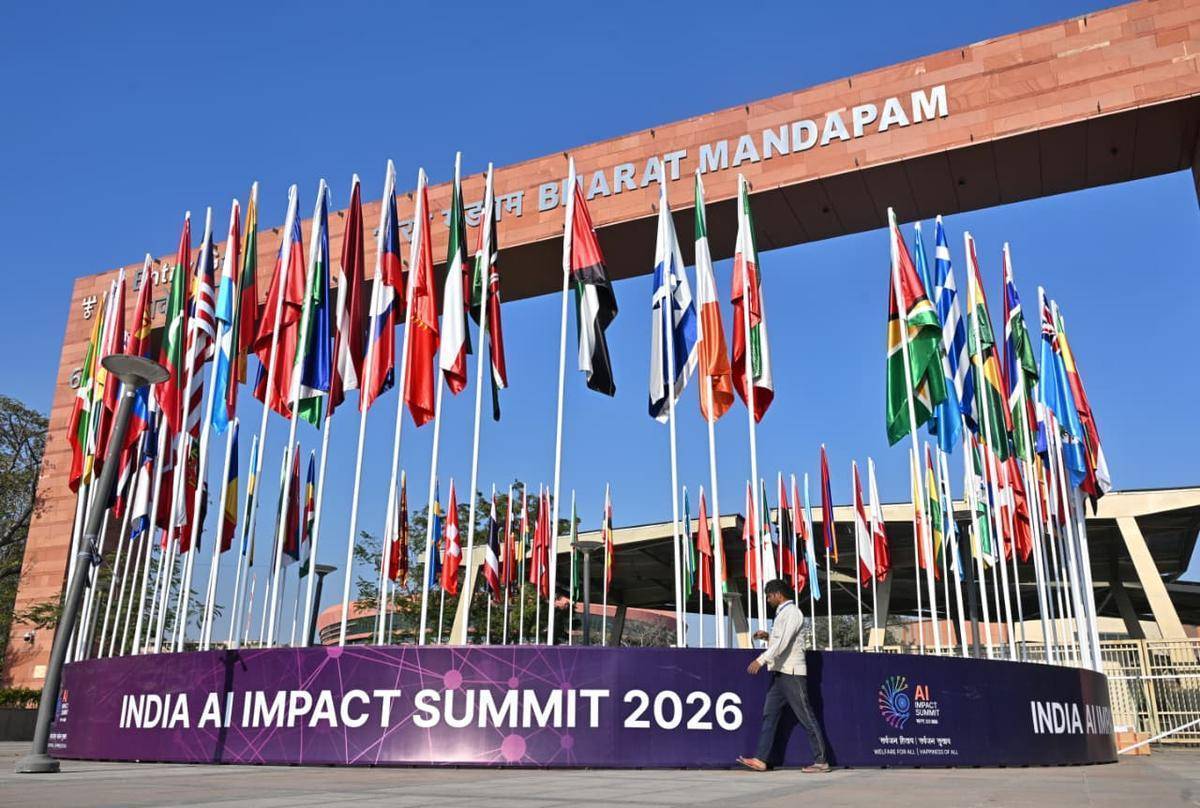
Key Highlights of the India AI Impact Summit 2026
- Historic Global AI Gathering – First-ever global AI summit hosted in the Global South, held at Bharat Mandapam.
- Global Participation – Leaders from 20 nations, including France, Brazil, Spain, UAE, and Mauritius.
- AI for Road Safety – Sessions on predictive modelling, crash analytics, and proactive interventions.
- Prime Minister’s Vision – PM Narendra Modi credits India’s citizens and digital ecosystem for driving AI leadership.
- Global AI Agenda – Summit promotes responsible deployment, equitable access, research, innovation, and public-private partnerships under the principles of People, Planet, and Progress.
The India-AI Impact Summit 2026 marks a defining moment in global technology diplomacy, positioning India at the forefront of responsible artificial intelligence leadership. Hosted in New Delhi on 16–20 February 2026, the summit represents the first global AI gathering of its scale to be held in the Global South—underscoring a shift toward more inclusive and representative global governance.
Taking place at Bharat Mandapam, and hosted by the Ministry of Electronics and Information Technology (MeitY), Government of India, the summit convenes policymakers, industry pioneers, researchers, and civil society leaders to collectively shape the next phase of AI evolution.
With over 100 nations invited and more than two lakh online registrations, the event reflects growing international consensus that AI governance must be collaborative, ethical, and development-oriented. Beyond dialogue, the summit aims to advance shared standards, cross-border partnerships, and scalable AI solutions that address global challenges, from healthcare and education to climate resilience and economic inclusion.
India’s role as both convenor and strategic partner signals its expanding influence in shaping a balanced AI ecosystem, mone that promotes innovation while safeguarding trust, accountability, and equitable access.
Global Participation
The summit will host world leaders from 20 nations, including:
- Emmanuel Macron – France
- Luiz Inácio Lula da Silva – Brazil
- Pedro Sánchez – Spain
- Guy Parmelin – Switzerland
- Dick Schoof – Netherlands
- Khaled bin Mohamed bin Zayed Al Nahyan – UAE
- Navinchandra Ramgoolam – Mauritius
- Anura Kumara Dissanayake – Sri Lanka
- Sebastien Pillay – Seychelles
- Tshering Tobgay – Bhutan
Additionally, ministerial delegations from over 45 countries, including Bolivia, Croatia, Estonia, Finland, Greece, Guyana, Kazakhstan, Liechtenstein, Serbia, and Slovakia, are participating. UN Secretary-General and senior officials from several international organisations will also join the deliberations.
The India – AI Impact Summit 2026 is the first-ever global AI summit hosted in the Global South, announced by Hon’ble Prime Minister Narendra Modi at the France AI Action Summit. The Summit will be inaugurated by the Prime Minister and is envisioned as the premier global forum for AI this year, promoting inclusive, action-oriented, and globally collaborative AI initiatives.
Building on the momentum of international forums such as the UK AI Safety Summit, AI Seoul Summit, France AI Action Summit, and the Global AI Summit on Africa, this Summit marks a critical inflection point in global AI cooperation. It seeks to translate high-level political commitments into tangible impact, fostering multilateral collaboration, shared progress, and actionable AI outcomes.
The Summit emphasizes a future where AI drives inclusive growth, social development, and people-centric innovations, while amplifying the voice of the Global South, ensuring that technological opportunities are widely accessible.
Guiding Principles – The Three Sutras
The Summit is anchored on three foundational pillars, known as Sutras—a Sanskrit term meaning guiding principles:
People – Harnessing AI to empower individuals and communities.
Planet – Driving sustainable AI solutions to protect the environment.
Progress – Promoting inclusive, equitable, and transformative growth through AI.
Focus Areas – The Seven Chakras
The deliberations at the Summit will be organized around seven Chakras, representing key domains for multilateral AI collaboration. Each Chakra translates the principles of People, Planet, and Progress into actionable areas:
- Human Capital – Building global AI talent, skills, and education initiatives.
- Inclusion for Social Empowerment – Ensuring AI benefits reach all sections of society.
- Safe and Trusted AI – Promoting ethical, secure, and responsible AI systems.
- Resilience, Innovation, and Efficiency – Enhancing organizational and societal adaptability through AI.
- Science – Advancing research and scientific collaboration in AI.
- Democratizing AI Resources – Making AI technologies, data, and tools accessible worldwide.
- AI for Economic Growth and Social Good – Leveraging AI to create sustainable development and societal impact.
AI Impact Summit 2026 – Agenda
- 16 Feb (Monday): Opening day with high-impact keynotes, policy-focused panel discussions, and expert roundtables. The India AI Expo is inaugurated, bringing together innovators, startups, industry leaders, and public institutions. The day sets the foundation for national AI priorities and collaboration.
- 17 Feb (Tuesday): Continuation of high-level panel discussions across key sectors. Launch of flagship AI Casebooks on Health, Energy, Education, Agriculture, Gender Empowerment, and Accessibility. Includes a focused seminar on Applied AI to explore practical AI applications.
- 18 Feb (Wednesday): Research Symposium featuring leading academics and think tanks showcasing cutting-edge AI research, methodologies, and evidence-based policy insights. Dedicated Industry Sessions highlight scalable solutions, real-world deployments, and future-ready innovations.
- 19 Feb (Thursday): Formal Opening Ceremony led by the Hon’ble Prime Minister of India. CEO Roundtable and Leaders’ Plenary convene global industry leaders, investors, and policymakers to discuss strategic priorities, partnerships, and India’s leadership in the AI decade.
- 20 Feb (Friday): GPAI Council Meetings for member countries to review progress, align priorities, and strengthen multilateral cooperation. The Leaders’ Declaration is adopted, outlining collective commitments and a shared roadmap for responsible global AI governance.
Key attendees at the India AI Impact Summit 2026:
- Aarthi Subramanian – COO & Executive Director, Tata Consultancy Services
- Ajay Vij – Senior Country Managing Director, Accenture India
- Alexandr Wang – Chief AI Officer, Meta
- Amit Zavery – President, CPO & COO, ServiceNow
- Ana Paula Assis – SVP & Chair APAC & EMEA, IBM
- Arthur Mensch – Co-Founder & CEO, Mistral AI
- Arundhati Bhattacharya – Chairperson & CEO, Salesforce India
- Bipul Sinha – CEO & Co-Founder, Rubrik
- Borje Ekholm – President & CEO, Ericsson Group
- Brad Smith – President & Vice Chair, Microsoft
- C Vijayakumar – CEO & MD, HCLTech
- Cristiano Amon – President & CEO, Qualcomm
- Dario Amodei – CEO, Anthropic
- Jay Chaudhry – CEO & Founder, Zscaler
- Jensen Huang – Founder & CEO, NVIDIA
- Harshil Mathur – CEO & Co-Founder, Razorpay
- Matthew Prince – CEO, Cloudflare
- Mukesh D. Ambani – Chairman & MD, Reliance Industries
- Nandan Nilekani – Co-Founder & Chairman, Infosys
- Raj Koneru – CEO, Kore.ai
- Rajesh Subramanian – CEO, FedEx
- Ravi Kumar S – CEO, Cognizant
- Rishad Premji – Executive Chairman, Wipro
- Roshni Nadar Malhotra – Chairperson, HCLTech
- Roy Jakobs – CEO, Royal Philips
- Salil Parekh – CEO & MD, Infosys
- Sam Altman – CEO, OpenAI
- Shantanu Narayen – Chair & CEO, Adobe
- Sundar Pichai – CEO, Google & Alphabet
- Vijay Shekhar Sharma – Founder & CEO, Paytm
- Vishal Sikka – Founder & CEO, Vianai Systems
- Prof. Yann LeCun – Executive Chairman, AMI Labs
- Prof. Yoshua Bengio – Founder & Chair, Mila Institute
- Prof. Stuart J Russell – Professor, UC Berkeley
- Prof. Surya Ganguli – Stanford University
- Prof. Subbarao Kambhampati – Arizona State University
- Prof. Priya Donti – MIT
- Prof. Ramesh Raskar – MIT Media Labs
- Prof. Monojit Choudhury – MBZUAI
- Prof. Neil Lawrence – University of Cambridge / DeepMind
- Prof. Alison Noble – University of Oxford
- Prof. Vukosi Marivate – University of Pretoria
- Raj Reddy – Carnegie Mellon University
- Amanda Brock – CEO, OpenUK
- Anne Neuberger – Strategic Advisor, Andreessen Horowitz
- Anne Robinson – SVP & Chief Legal Officer, IBM
- Aparna Bawa – COO, Zoom
- Bejul Somaia – Partner, Lightspeed
- David Zapolsky – Chief Global Affairs & Legal Officer, Amazon
- Farzana Haque – Philanthropist & Investor
- Ivana Bartoletti – VP, Wipro
- Jason Oxman – President & CEO, ITI
- Jeetu Patel – President & CPO, Cisco
- Natalie Black – Group Director, Ofcom
- Natasha Crampton – VP & Chief Responsible AI Officer, Microsoft
- Government, Policy & Global Organizations
- Børge Brende – President & CEO, World Economic Forum
- Dame Melanie Dawes – Chief Executive, Ofcom
- Ibrahim Hafeezur Rehman – Director-General, NAMTECH
- Tony Blair – Executive Chairman, Tony Blair Institute
- Uday Shankar – Vice Chairman, JioStar
- Dr. Archana Sharma – Principal Scientist, CERN
- Dr. Kalika Bali – Senior Principal Researcher, Microsoft Research
- Dr. Liming Zhu – Head AI & Digital, CSIRO
- Dr. Manish Gupta – Senior Director, Google DeepMind
- Dr. Pushmeet Kohli – VP of Science, Google DeepMind
- Dr. Sara Hooker – Co-Founder, Adaption Labs
- Dr. Shivkumar Kalyanaraman – CEO, ANRF
- Dr. Sunayana Sitaram – Principal Researcher, Microsoft
- Dr. Venkat Padmanabhan – Managing Director, Microsoft Research
- Eric Grimson – Chancellor, MIT
Focus Areas and Key Sessions
The summit’s discussions span governance, safety, and economic transformation, reflecting AI’s cross-sectoral impact.
On the legislative front, Raghav Chadha, Member of Parliament from the Aam Aadmi Party, is presenting on “Power, Protection and Progress – Legislators and the AI Era.” His address emphasizes the urgent need for governance frameworks that strike a balance between rapid technological advancement and robust public safeguards.
The opening session places strong emphasis on AI for road safety, where experts are examining crash analytics, predictive modelling, and proactive intervention strategies aimed at reducing fatalities and improving transportation systems.
Addressing economic dimensions, V. Anantha Nageswaran, Chief Economic Advisor to the Government of India, called for coordinated and time-bound action to ensure AI supports broad-based, inclusive growth. He stressed the importance of skill development, regulatory reforms, and innovation ecosystems that translate AI advancements into tangible socio-economic outcomes.
Prime Minister’s Vision
In his keynote address, Narendra Modi welcomed global delegates and credited India’s 1.4 billion citizens for driving the country’s AI momentum. He noted that India’s AI journey reflects its ambition, accountability, and innovation-led growth model.
The Prime Minister highlighted the country’s strong digital public infrastructure, vibrant startup ecosystem, and expanding research capabilities as foundational pillars supporting AI leadership. He reaffirmed India’s commitment to ensuring that AI remains ethical, human-centric, and development-oriented—serving as a force multiplier for inclusive progress both domestically and globally.
The India AI Impact Summit 2026 marks a pivotal moment in India’s leadership in shaping the global artificial intelligence agenda. More than a diplomatic forum, it represents a strategic commitment to advancing AI that is responsible, equitable, and outcome-driven—ensuring technological progress translates into tangible benefits across every sector of society.
Hosted at Bharat Mandapam, the summit goes beyond dialogue to focus on delivery. It lays the foundation for converting global commitments into practical, scalable initiatives that promote inclusive economic growth, strengthen social development, and deepen multilateral collaboration. A key priority is amplifying the voice of the Global South, ensuring that emerging economies actively shape—not just adopt—the rules and frameworks governing AI.
Anchored in the principles of People, Planet, and Progress, the summit emphasizes:
- Responsible and ethical AI deployment grounded in transparency and accountability
- Equitable access to technology, high-quality data, and future-ready digital skills
- Strong research ecosystems and public–private partnerships to accelerate innovation
By advancing shared standards, ethical governance frameworks, and interoperable solutions, India seeks to position AI as a transformative force for sustainable and people-centric development. The summit reinforces a global vision where innovation and responsibility move forward together—placing inclusion, cooperation, and long-term impact at the heart of the AI revolution.
Image- thehindu.com





.png)