
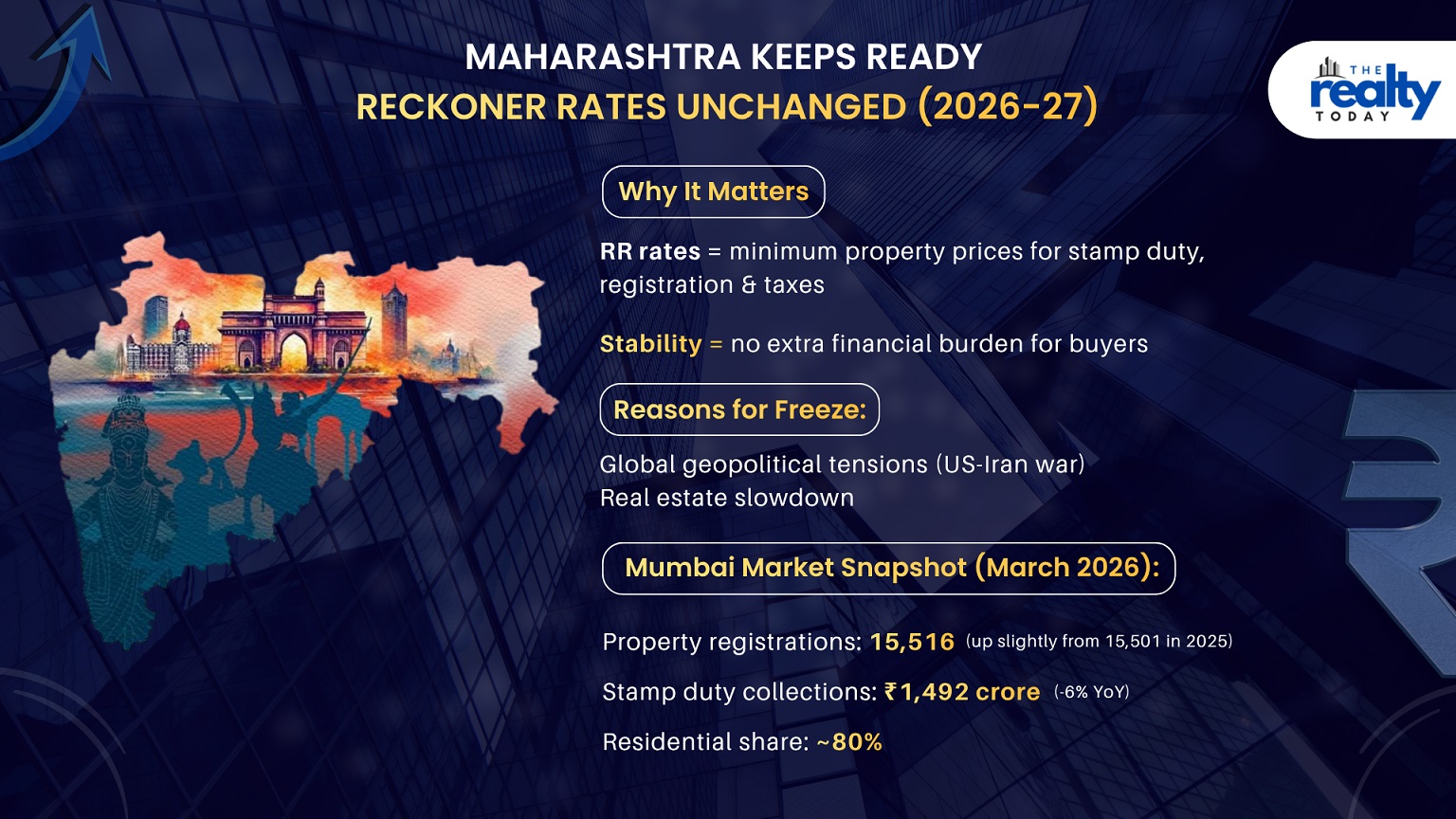
As the real estate market is facing slowdown, the Government of Maharashtra decided that the ready reckoner (RR) rates will remain the same for the year 2026-27 in order to bring some stability in the market. Revenue Minister Chandrashekhar Bawankule said continuing geopolitical tensions and real estate deceleration along with other factors have forced them to refrain from increasing the RR rates statewide, which will help the common man to some extent in managing his financial burden.
Ready Reckoner rates are the standard property values set by the government for different types of properties. These rates are used specifically for property registration and the calculation of stamp duty.
They play an important role in determining the values of transactions, capital gains tax, and charges payable to municipal authorities by real estate developers. By stabilizing RR rates, the government intends to supply an element of predictability in property costs for both buyers and developers.
- RR rates are used to calculate stamp duty and registration fees.
- They influence property transaction values and overall affordability.
- Stability in RR rates helps maintain confidence in the real estate market.
According to the Maharashtra Revenue Ministry, “For the year 2026-27, since rates have been kept stable across all locations throughout the entire state, the common citizen’s pocket will not face any additional financial strain.”
Historical Context of RR Rate Adjustments
Maharashtra government had last increased the RR rates in 2025-26 after two years gap, with an average increase of 3.89%. Before that, the rate was increased by 4.81% in 2022-23. In 2020-21, a slight 1.74% incremental was made due to the pandemic. Choosing to keep the rates unchanged this year is a deliberate move to support the real estate sector and homebuyers at a time when global uncertainties are causing market fluctuations.
- 2025-26: Average hike of 3.89%
- 2022-23: Average hike of 4.81%
- 2020-21: Modest hike of 1.74% due to the pandemic
The global situation, especially the ongoing US-Iran war and its impact on construction costs, has prompted developers and policymakers to focus on stability,” Bawankule stated.. “Considering inputs from industry associations such as CREDAI, relevant suggestions, and objections, the government has maintained the rate-hike percentage at ‘nil’ to boost the construction sector. Market values have been determined taking into account the ground realities regarding properties.”
Stability Encourages Confidence
Real estate developers welcomed the government’s decision, noting that an increase in RR rates could have triggered a dual pressure on property prices. With global geopolitical tensions driving up construction costs, any additional hike in RR rates could have made homes significantly more expensive for buyers.
Niranjan Hiranandani, Chairman of NAREDCO National, stated that RR rates directly impact transaction values, stamp duty, and overall affordability; hence, maintaining the status quo provides much-needed confidence to both homebuyers and developers. It ensures that demand momentum, particularly in the mid-income and affordable segments, is not disrupted. Stability in policy becomes a critical enabler for sustained growth.
Stamp Duty Collections and Property Registrations
While RR rates remain unchanged, stamp duty collections in Maharashtra have shown some fluctuation. According to government data, the target for stamp duty collection for 2026-27 was around ₹65,000 crore. As of March 31, 2026, the government had collected over ₹60,000 crore, representing roughly 95% of the estimated target.
Meanwhile, the Mumbai real estate market continues to display resilience. In March 2026, the city recorded 15,516 property registrations, a marginal increase from 15,501 registrations in March 2025. However, stamp duty collections fell by 6% year-on-year to ₹1,492 crore from ₹1,589 crore in the same period last year. Experts attribute this dip to changes in the transaction mix, while sequential month-on-month data indicates a strong close to the financial year, with registrations rising 19% and stamp duty collections increasing by 32% compared to February 2026.

Dharmendra Raichura, VP and Head of Finance, Ashar Group, said, " At a time when global uncertainties and evolving geopolitical dynamics are influencing economic sentiment, the decision to maintain status quo on ready reckoner rates for 2026–27 is both timely and reassuring. It reflects the government’s clear intent to prioritise stability and safeguard homebuyer sentiment by ensuring there is no additional financial burden through increased stamp duty.
Notably, this comes after a calibrated average increase of 3.89% in ready reckoner rates in 2025–26, following a two-year pause, indicating a balanced and phased approach to rate revisions. By choosing to hold rates steady this year, the government has reinforced policy consistency at a crucial juncture.
In a market like Thane, where end-user demand remains resilient, this move will help sustain buying momentum, improve affordability, and encourage fence-sitters to make purchase decisions. It also strengthens investor confidence by offering predictability. Overall, such measured interventions play a vital role in building trust, stabilising market sentiment, and enabling sustainable, long-term growth in Maharashtra’s real estate sector."
Residential properties continue to dominate the market, accounting for nearly 80% of all registrations. This reflects a strong demand for homes even amid a challenging macroeconomic environment.
The Maharashtra government's decision to keep the RR rates unchanged is geared towards maintaining affordability and encouraging the continuation of property transactions. Experts believe that this policy might help homebuyers in the middle-income bracket and also avoid any potential setbacks in the construction and real estate sectors because the world average geopolitical tensions, supply chains issues, and increasing prices of materials are the main factors that keep affecting these markets. As the 2026-27 financial year progresses, the government's balanced stance is expected to be a source of advantage for both developers and buyers.
The steadiness in RR rates offers a property transaction setting that is easy to anticipate, which in turn helps to keep the desire in the residential areas at a good level and allows the construction sector to experience growth despite the existing worldwide imponderables. With this move, the Maharashtra government is making a statement that it wants to focus on market stability, affordability, and citizen interest protection even in times when the world is easily shaken by global challenges.






.png)