
Purchasing a house is one of the biggest investments that people undertake in their lives.
While the buyers try to compare many things related to location, price, connectivity, amenities, and the reputation of the developer, one of the most crucial factors that determine the actual value of the property gets ignored, the carpet area.
Most of the people buying a house believe that the size of the apartment that has been mentioned in brochures is the living space they are going to get. But this is not necessarily the truth because the comparison between the carpet area, built-up area, and the super built-up area can have a major impact on the space available and eventually the property's value.
To remove all kinds of confusion in the real estate sector and ensure transparency in dealings, it has become compulsory under the Real Estate (Regulation and Development) Act, 2016 (RERA), that the developers must offer the residential unit based on RERA carpet area instead of the super built-up area.
What is a Carpet Area?
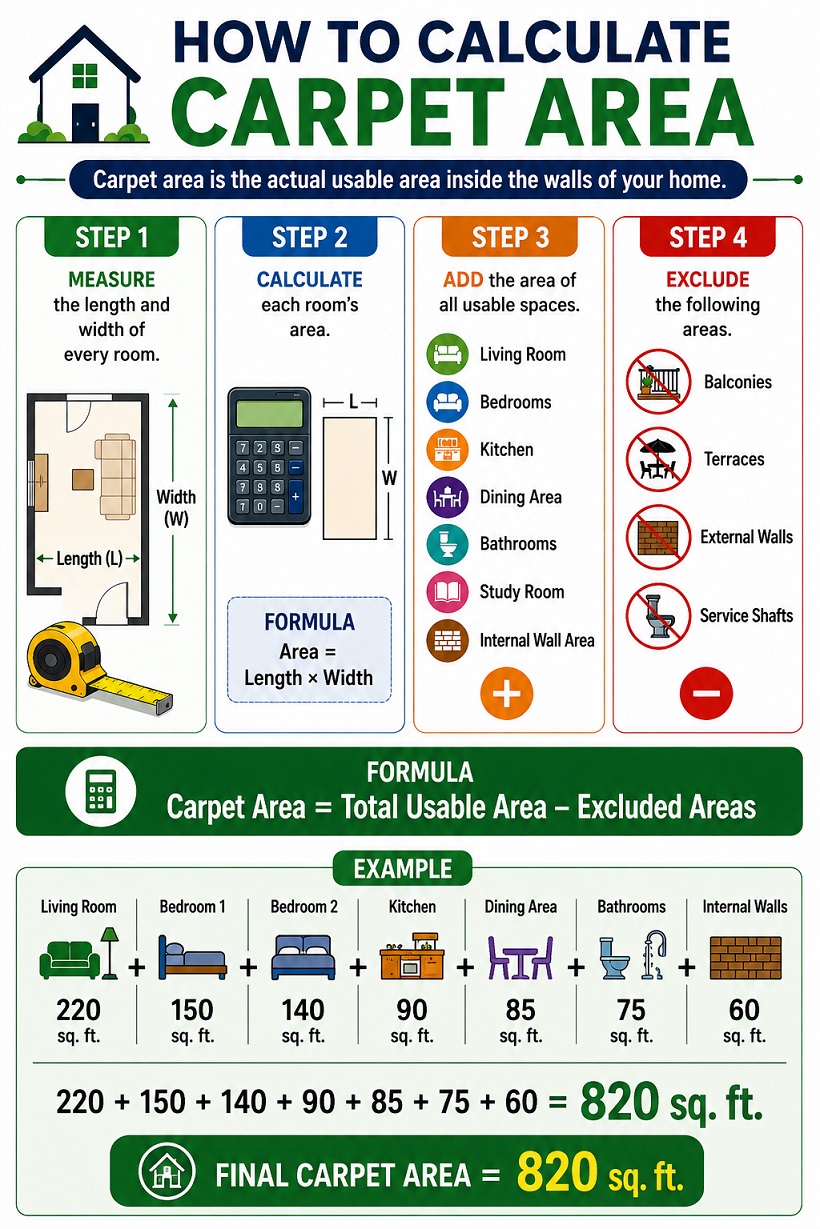
Carpet area as per the RERA Act, means:
"The net usable floor area of an apartment inclusive of the area within the internal partition walls but exclusive of external walls, service cores, exclusive balconies, verandahs and open terraces."
What Led To The Implementation Of Carpet Area Rules?
At a time when most developers were offering flats using their super built-up area before the enforcement of Real Estate (Regulation and Development) Act (RERA), this figure incorporated not only the space inside the home that could be utilized but also the owners' shares in common areas like staircases, lift lobbies corridors clubhouses, common halls and other shared facilities for recreation.
This led consumers to think that they had purchased much bigger residences with the usable space they would have at their disposal. For instance, an apartment marketed as 1,500 sq. ft. would have carpet area only of 1,050 sq. ft. Because of this creating a noticeable distance between the size that was being advertised and the area one can actually live in.
The absence of a standardized method of measurements was among the primary reasons for many confusion issues, conflicts and low levels of transparency in real estate deals. RERA's regulation to adopt carpet area as the main method for the sales of homes has put consumers in a better situation as they get to pay as the actual usable ground area of the flat itself and nothing else. This should definitely stop any misleading by sellers.
RERA tackled the problem by setting a single standard for calculating carpet area which not only made it simpler to find out exact measurements but also created more level playing field among property sellers.
Knowing that it is the buyer who gets the actual usable space based on the size of the carpet area he is paying for, will lead the buyer to be able to know the true price of the product, to make accurate comparisons with other projects and then make a well-informed purchase decision.
The consumer will be more confident in the price he is being quoted since he will be able to see the breakdown of the price per the various elements; he will be able to compare one project with another more easily because he just needs to look at the sizes and prices;
Factors that Determine RERA Carpet Area
RERA carpet area is the sum of all the parts of the floor that are enclosed with the internal walls and which are completely usable. For instance, it includes the living room bedrooms hall kitchen bathrooms, study room, internal utility area, storage room, and also the area taken up by internal partition walls. All these are the home owner's areas where one would use daily.
Understanding the Different Area Measurements
Buyers often get so confused in understanding their apartment areas due to varied descriptions and the usage of different expressions for describing them.
- Carpet Area: The actual floor usable space within the flat/apartment including area covered by internal walls and the like.
- Built-up Area: And carpet area it also includes external walls thickness, balconies and attached utility spaces. The area is usually 10, 20% more than carpet area.
- Super built-up area includes the built-up area with a proportionate share of common areas like corridors lift lobbies staircases and clubhouses and other shared areas.
Although the apartment may be advertised as 1,350 sq. ft., the homeowner actually receives only 1,000 sq. ft. of usable living space.
The Secret Mathematics That Determines Real Estate Price
Most homebuyers assume that the price per square foot quoted by the sales representative reflects the cost of the actual usable area. However, this is often not the case.
Example:
- Advertised Area (Super Built-up): 1,500 sq. ft.
- Apartment Price: ₹1.80 crore
Many buyers calculate:
₹1.80 crore ÷ 1,500 sq. ft. = ₹12,000 per sq. ft.
However, if the actual carpet area is only 1,050 sq. ft., the effective cost becomes:
₹1.80 crore ÷ 1,050 sq. ft. = ₹17,143 per sq. ft.
The effective price of the usable living space is ₹17,143 per sq. ft., not ₹12,000 per sq. ft.
This is why buyers should always compare property prices based on carpet area, as it represents the actual usable space inside the apartment.
Why RERA Carpet Area Matters?
- Project evaluation made easy: It is through the carpet area that buyers can easily compare different projects as this becomes the base for a fair comparison. Take, for instance, Project A has a carpet area of 950 sq. ft. while Project B, with carpets, is of 1,050 sq. ft. so Project B comes 100 sq. ft. ahead with living space, even if they are super built up areas similar.
- Creative reduction of misleading advertising: The RERA system offers a standard approach to calculate building area which brings a significant reduction of advertising based on a much overstated super built-up area figure.
- Equitable Remuneration: Consumers may expect reimbursement or reasonable modifications based on the carpet area that the house delivered was less than that mentioned in the Agreement for Sale.
Carpet Area and Home Loan Assessment
Home loan approval depends largely on the value of the property in the market. Carpet area plays an important role during valuation of the property since it is a measure of the usable area.
Properties that have larger carpet area and are efficient in their design and function are usually considered more valuable and offer good resale value when compared with apartments having the same super built up area but less usable space.
Carpet Area and Property Taxes
Property tax calculation depends largely on the local municipality guidelines, which may base themselves on factors like built up area, unit value, annual rental value or capital value, depending on the locality.
Though carpet area may not necessarily play any role in the calculations of property tax, maintaining information about carpet area, sanctioned plans, and sale agreements can be helpful in avoiding disputes in future.
Common Mistakes Buyers Make
- Comparing only the advertised apartment size instead of the actual carpet area.
- Ignoring the loading percentage while comparing similar-sized apartments.
- Assuming balconies, terraces, and verandahs are included in the carpet area.
- Not verifying the project's RERA registration and carpet area details.
- Overlooking the floor plan and space efficiency.
- Comparing properties based only on the quoted price per square foot instead of the effective price per carpet square foot.
How to Check for Carpet Area Verification?
While considering a purchase, buyers should:
- Check their RERA registration details.
- Verify the carpet area specified in the Agreement for Sale.
- Study the approved floor plan.
- Ask for an area statement from the developer.
- Compare the agreement with marketing brochures.
- Compare the carpet area in RERA certificate, sanctioned building plan, allotment letter, possession papers, and sales agreement.
- If needed, seek clarification from an independent architect or surveyor.
Questions that Every Home Buyer Must Ask
While buying an apartment, the developer must provide answers to the following questions:
- What is the carpet area as per the RERA registration?
- What is the built-up area?
- What is the super-built up area?
- What is the loading percentage?
- Are balconies/terraces counted separately?
- Does the quoted price include parking costs?
- Is the carpet area specified in the Agreement for Sale the same as per RERA?
- Are there any changes to the approved floor plan?
Penalties for Misrepresentation
The RERA Act contains provisions to protect homebuyers from incorrect disclosures. If a developer provides misleading information regarding the carpet area or other project details, buyers have the right to approach the respective State RERA authority for appropriate relief, including compensation where applicable.
Accurate disclosure of carpet area has therefore become an important compliance requirement for developers and an important safeguard for homebuyers.
Conclusion
Carpet area is much more than a technical specification, it is the measurement that reflects the real, livable area that homebuyers are handed over. Plus factors like location, construction quality, connectivity, and the availability of facilities, carpet area helps the buyers assess the true value of the property and compare projects on a level footing.
All the same, buyers shouldn't be blinded by the pictures in the booklet or the stated apartments sizes only. They must compare the effective price per carpet sqft, study the approved layout plan, confirm the RERA registration details, check loading percentage and all these factors of the property only then they should buy the property.
The real hidden number behind your property price tag isn't the figure printed in the flyer, but rather the amount of physical real estate that you end up actually occupying. Understanding the principles of carpet area, and the methods used to determine property prices equips homebuyers to make wise choices, carry out effective bargaining and be fully satisfied with such an investment they make for their lives.