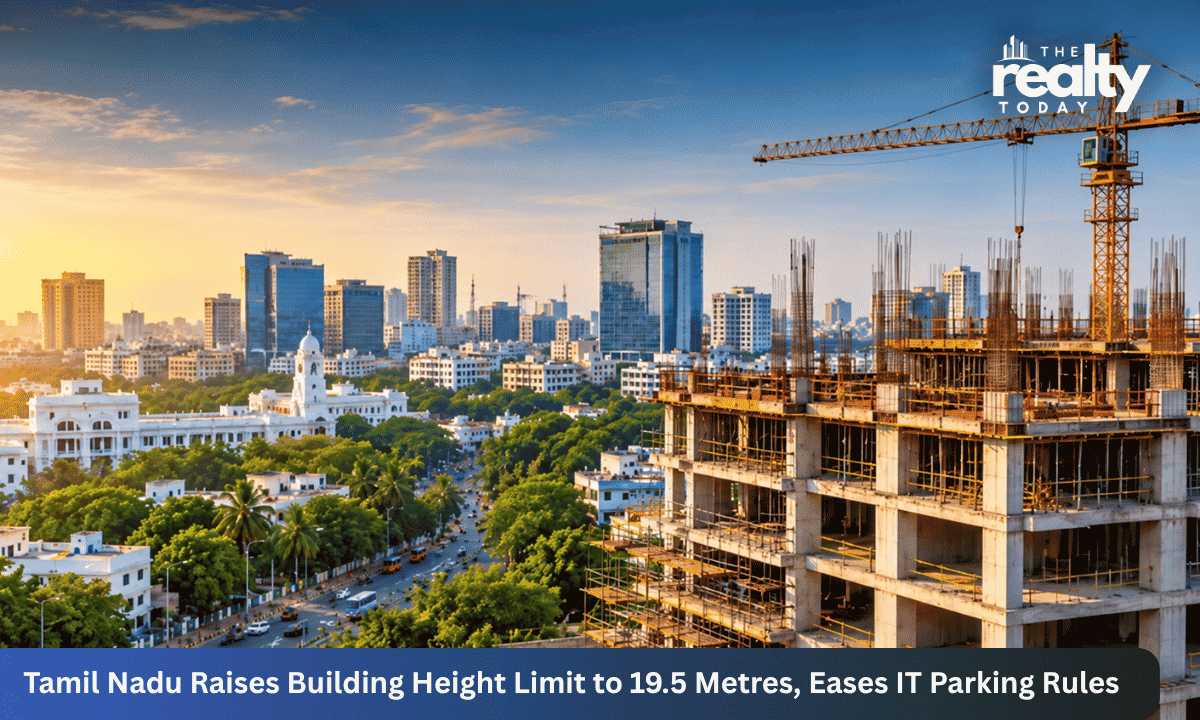
Tamil Nadu has revised its building regulations, increasing the maximum permitted height for specified non-high-rise buildings from 18.3 metres to 19.5 metres. The amendments also ease parking requirements for IT offices and revise rules governing commercial development and construction in Chennai’s restricted aquifer recharge area.
Amendments have been made to the Tamil Nadu Combined Development and Building Rules, 2019, by the Housing and Urban Development Department of Tamil Nadu on October 26, 2026. These changes will provide more flexibility for builders and developers to plan their residential and commercial projects, especially in established areas of Chennai where land is scarce. But projects will be required to comply with the relevant FSI, road width, setback and other planning requirements. The state has also been exploring ways to speed up construction approvals through an
AI-based system.Tamil Nadu Revises Height Rules for Non-High-Rise Buildings
The maximum permitted height for specified non-high-rise buildings has increased to 19.5 metres from 18.3 metres. The revised limit applies to certain building categories, including some institutional buildings and transport terminals.
This provides architects and developers with extra flexibility when designing buildings such as ceiling heights and layout. However, this does not mean that all buildings can have an additional storey as there are still built up area limitations to adhere to.
The changes also maintain current FSI requirements for high rise buildings. This remains at 2.0 for 12m roads, 2.5 for 15m roads and 3.25 for 18m roads. Setback and plot-coverage requirements will also continue to influence the scale of development permitted on individual sites.
New Parking Rules Ease Requirements for IT Offices
The revised rules reduce parking requirements for information technology offices, IT-enabled services and bioinformatics centres. Eligible establishments must provide one car parking space for every 75 sq metres of floor area, compared with one space for every 50 sq metres previously.
The requirement for two-wheeler parking has also been reduced, from one space for every 25 sq metres to one for every 50 sq metres.
The changes could reduce the amount of space developers need to allocate to parking in eligible office projects. This may improve the efficiency of building layouts and reduce the need for extensive podium or underground parking, depending on the project.
The actual benefit will vary according to site conditions, building design and other applicable requirements. The revised ratios do not, by themselves, guarantee lower construction costs or additional leasable office space.
Tamil Nadu's revised building norms
| Requirement | Earlier Rule | Revised Rule |
| Non-high-rise building height | 18.3 m | 19.5 m |
| IT office car parking | 1 per 50 sq m | 1 per 75 sq m |
| IT office two-wheeler parking | 1 per 25 sq m | 1 per 50 sq m |
| Aquifer-zone building height | 9 m | 14 m |
Tamil Nadu Revises Road Rules for Commercial DevelopmentThe amendments also revise the conditions under which certain sites in designated residential and primary residential zones can qualify for commercial use. In the Chennai Metropolitan Area, eligible plots in designated residential and primary residential zones may qualify for commercial use if they abut and have access to a road at least 12 metres wide, with the required width available continuously for 250 metres. The provision remains subject to the conditions specified in the amended rules.
This will provide more flexibility for commercial development along roads that meet the criteria. It will provide flexibility along roads where there were land use restrictions. It may also make some sites more attractive to developers considering office buildings or mixed-use projects.
The revised provision does not automatically allow every residential property along a wider road to be converted for commercial use. Eligibility will depend on the amended rules and the applicable planning and approval requirements.
Chennai Aquifer Zone Gets Higher Building Height Limit
The state has also relaxed certain restrictions in Chennai’s restricted aquifer recharge area, where development is regulated to protect groundwater resources. The permitted height for specified non-high-rise residential and commercial buildings in the covered area has increased from 9 metres to 14 metres, while the six-dwelling-unit limit remains for the relevant category.
The change could allow greater flexibility in some developments that were previously restricted to lower heights, although the applicable conditions will continue to determine what can be built.
Taken together, the amendments address several aspects of development, from building height and parking to commercial land use and construction in restricted areas. Their impact on Chennai’s real estate market will depend on how many sites qualify under the revised rules and whether developers can turn the additional flexibility into viable projects.
The changes may create opportunities for more efficient land use, but any increase in housing or office supply will depend on project approvals, construction decisions and market demand.