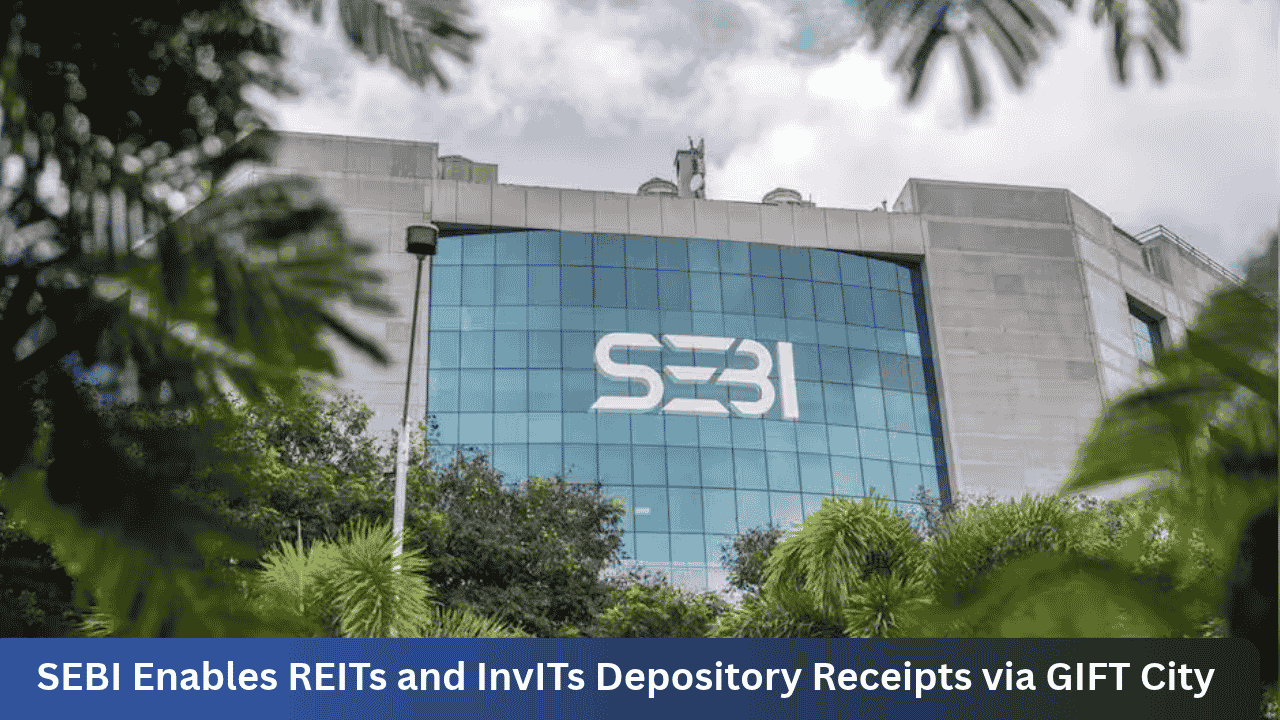
The Securities and Exchange Board of India has issued norms to enable Real Estate Investment Trusts (REITs) and Infrastructure Investment Trusts (InvITs) to launch depository receipts for their units to give foreign investors an alternative avenue to invest in the Indian realty and infrastructure sector.
The depository receipts can be listed on India International Exchange (India INX) and NSE International Exchange, GIFT City, Gujarat under the new norms issued on November 2.
This will help eligible overseas investors to invest in REITs and InvITs units in India.
These are instruments issued by a depositary against the securities of REITs and InvITs units held with a domestic custodian. The framework sets out how these receipts can be issued and traded, along with the conditions that trusts must meet.
A New Route for Overseas Investment
REITs allow investors to participate in income-generating real estate assets, including commercial office buildings, without directly purchasing property. InvITs follow a similar structure but invest in infrastructure assets such as roads and power transmission networks.
The new framework creates an additional route for overseas investors to access these investment vehicles. Foreign investment in Indian REITs and InvITs was already permitted under existing regulations. The latest move introduces a specific mechanism for issuing depository receipts against their units.
The framework follows a consultation process initiated in August 2026, when SEBI proposed rules for issuing depository receipts against REIT units and publicly listed InvIT units. The detailed circulars issued on November 2 set out the requirements for carrying out such transactions.
GIFT City Exchanges to Facilitate Listings
The framework permits depository receipts to be listed on India INX and NSE International Exchange, both operating from GIFT City's International Financial Services Centre.
REITs and InvITs can issue fresh units for the purpose of creating depository receipts or facilitate the transfer of existing units held by investors. The underlying units are held with a domestic custodian, while a foreign depositary issues the corresponding receipts for listing on the permitted exchanges.
Trusts planning simultaneous domestic and international listings must obtain approval from the relevant Indian and international exchanges. The process also involves appointing a merchant banker and meeting the prescribed filing and disclosure requirements.
SEBI Prescribes Approval and Pricing Conditions
The regulator has set conditions governing fresh issues and investor participation. In general, a fresh issue of units for depository receipts requires approval from at least 75% of unitholders voting in favour of the proposal.
An exception applies when units and depository receipts are issued together as part of an initial offer. The framework also provides for subsequent offerings within the overall limit already approved by unitholders.
A pricing safeguard has been included to ensure that units issued for depository receipts are not priced below the price offered to domestic investors for a similar issue. Additional eligibility requirements apply to participating investors and the trusts undertaking such issues.
Fresh issues against privately placed InvIT units are subject to specific restrictions, with participation limited to eligible foreign institutional investors and corporate bodies.
What It Could Mean for India's REIT Market
The framework gives Indian REITs another channel to reach overseas investors and could widen the investor base for the country's listed REIT market. For trusts holding income-generating commercial properties, access to a wider pool of investors may provide an additional option when raising capital.
The move also adds to GIFT City's role as an international financial services centre by enabling the listing of these instruments through its exchanges.
However, the introduction of the framework does not guarantee immediate fundraising or increased foreign investment. Actual issuances will depend on individual trusts, the required approvals, regulatory compliance and investor interest. Its impact on India's REIT market will become clearer as trusts assess the option and decide whether to use the new route.