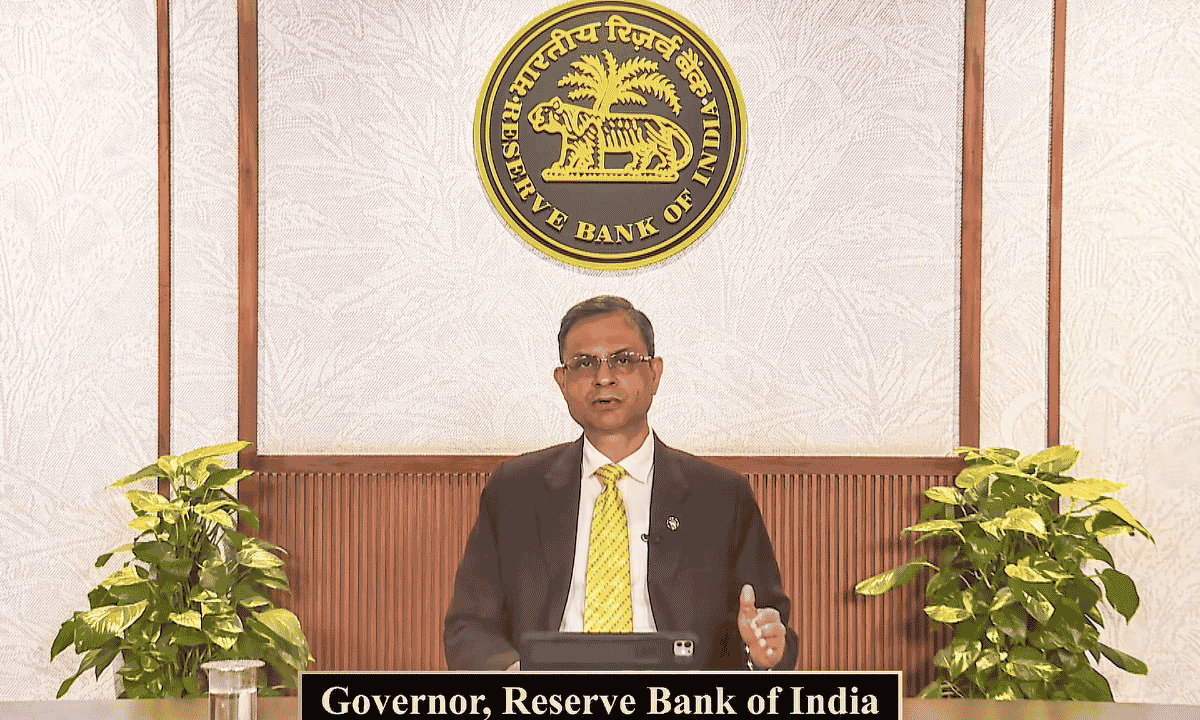
The Reserve Bank of India (RBI) has raised the repo rate by 25 basis points to 5.5%, marking the first increase in the key policy rate since February 2023. The decision was taken unanimously by the Monetary Policy Committee (MPC), headed by RBI Governor Sanjay Malhotra, amid concerns over rising inflation, higher oil prices and a weaker rupee.
The repo rate has been increased from 5.25% to 5.5%. The repo rate is the rate at which the central bank lends money to commercial banks, and changes in the rate can influence borrowing costs across the economy. Banks may adjust lending rates in response, affecting loans such as home loans, personal loans and vehicle loans.
The rate hike comes at a time when inflationary pressures are increasing, with higher crude oil prices adding to the cost of transportation, production and other economic activities. A weaker rupee can also raise the domestic cost of imported commodities, particularly crude oil, adding further pressure on prices.
For borrowers, the increase could translate into higher interest costs if banks pass on the rate hike to customers. Home loan borrowers with floating-rate loans could see their interest rates or loan tenures affected, depending on how individual lenders revise their lending rates. Prospective homebuyers may also need to reassess borrowing costs as lending rates respond to the RBI's decision.
The RBI's move also signals a shift from the rate-cutting environment seen in earlier periods. By raising the repo rate, the central bank is seeking to contain inflationary pressures while maintaining financial stability. The impact of the decision on consumer spending, credit demand and the broader economy will depend on how inflation, oil prices and currency movements evolve in the coming months.
Industry Experts Opinions

Mr Mehul H Doshi President CREDAI CHENNAI,
"We do not expect the marginal increase in interest rates to have any significant impact on housing sales or overall homebuyer sentiment. While the hike may result in a slight increase in the cost of borrowing, for instance, based on the current hike, the increase in EMI for a 15-year home loan would be only around Rs. 14 per lakh of loan amount. This translates into a relatively modest increase in the monthly repayment burden and is unlikely to materially influence the home-buying decision of serious and long-term buyers.
The housing market continues to be supported by strong underlying demand, particularly from end-users, and homebuyers are increasingly looking at property as a long-term investment. Therefore, we believe the marginal rise in borrowing costs is unlikely to significantly affect housing demand, sales momentum, or the broader growth trajectory of the residential real-estate sector."
Mr. Mukesh Choudhary, Managing Director, Accuspace, a real estate company,
"A repo rate hike and signal of future hikes could have some impact on the office real estate segment, primarily through higher financing costs and its potential influence on corporate expansion and capital expenditure decisions. However, seeing the underlying demand for quality office space which remains supported by business expansion, GCC growth and the need for modern, well-located workplaces, the demand for office space will continue its momentum. Developers may see some increase in the cost of capital, but projects with strong tenant visibility, robust fundamentals and good connectivity are likely to remain attractive. A stable interest-rate environment would, of course, provide greater confidence for new development and investment decisions, but we believe the office market can remain resilient even in a moderately higher-rate environment."

Mr. Ankur Jalan, CEO, Golden Growth Fund (GGF), a category II Real Estate focussed Alternative Investment Fund (AIF)
"A repo rate hike, in view of the rising inflation, will have a broader impact on the cost of capital across the real estate ecosystem. For AIFs, which typically deploy patient institutional capital into development, redevelopment and asset-backed opportunities, a higher interest-rate environment can influence project financing costs, acquisition valuations and investment timelines. At a time when institutional capital is showing strong confidence in Indian real estate, policy stability remains important for maintaining investment momentum. A rate hike, which could be transmitted by banks within 1-3 months, could also make developers and investors more selective, with greater emphasis on projects with strong fundamentals, execution visibility and clearly defined exit strategies."

Mr. Suresh H. A., Managing Director, Sanjeevini Group,
"The residential market continues to be supported by strong end-user demand, employment growth and infrastructure-led development despite the increase in home prices. A repo rate hike at this stage and signal of further hikes in the future may impact housing demand going forward and further put some pressure on affordability by increasing home-loan costs, particularly for first-time and financing-dependent buyers. However, banks could hold on to the current rates with a view to support the festive consumption boost as stable interest-rate environment would help sustain buyer confidence and provide greater visibility to both homebuyers and developers."

Mr. Lalit Parihar, Managing Director, Aaiji Group, a real estate firm
"The residential market has shown resilience, with sales continuing to remain steady despite evolving macroeconomic conditions. However, a repo rate hike and indication of further hik in the future will have an impact on homebuyer sentiments as they may prefer to postpone their purchase especially in the mid-income segment. While repo rate hike has become inevitable in view of the rising inflation, banks may prefer to wait until the passage of festive season to pass on the rate increase. Affordability is already a concern among buyers and by increasing borrowing costs may hurt certain section of homebuyers."
Mr. Anurag Goel, Director,Goel Ganga Developments
“Coming to the home loan segment, the increase in repo rate will directly impact floating rate borrowers and hence have a bearing on the overall demand for real estate. Taking the example of a Rs 50 lakh loan at 20 year tenure, a 25 basis point increase will result in additional EMI of around Rs 780 per month or Rs 1.88 lakh extra interest payout over the life of the loan. While lenders may also look to increase the tenure to reduce EMI burden, it will continue to be a challenge for first time buyers to qualify for a home loan. For investors looking to leverage on homebuyer tax benefits, a higher down payment will be required. While real estate demand will not collapse, affordability will take a hit.”
Mr. Vijay Raundal, Managing Director, Teerth Realties.
“As far as commercial real estate is concerned, the transmission of increase in repo rate will have varied impact on office space, warehousing and retail segment, with demand being driven by business cycles and return to office trends. With increased borrowing cost, cap rates for commercial real estate may also see increase, with impact being more visible on REITs and institutional investors. While demand for Grade A offices with assured rentals will sustain, there may be further delay in refinancing for weaker assets. For retail real estate, increase in EMI burden may further reduce footfalls with discretionary spending being curtailed, with impact being more visible on capital expenditure and new supply in the short term. Stability in money market rates is critical for commercial real estate to maintain its appeal as an asset class.”
HS Kandhari, Co-founder & Executive Director, Harmony Infra
“The 25-basis-point repo rate hike will add to borrowing costs as lenders revise their rates, with buyers on tighter budgets likely to feel the impact more. In luxury housing, I expect the immediate effect on demand to be limited, as purchases are also shaped by lifestyle needs, financial strength and long-term ownership plans. Buyers taking sizeable home loans may review their financing costs, while the prospect of further rate hikes could lead some to take longer to decide. This increase alone is unlikely to cause a sharp change in demand, but the future direction of rates will matter. Buyers will continue to weigh the quality of the home, its value and the developer’s delivery record.”
Mr. Nikhil Mawale, Co-Founder & CEO, PropertyDrone Realty,
“The increase in fixed deposit rates will also have an impact on capital allocation with real estate having to compete with safer investment options on the table. End users considering fixed deposit versus real estate must factor in the illiquidity of the latter and associated maintenance cost. A 25 basis point increase in repo rate will lead to reallocation of savings by conservative investors away from second home purchases and land banking. With affordability and liquidity being the primary concern, end-users must focus on ready to move inventory. Buyers should look to negotiate on prices and leverage on existing benefits to offload inventory. With another round of rate hike expected later this year, higher EMI burden will further reduce affordability in the real estate sector.”

Mr. Manik Malik, CEO & President, BPTP,
"The RBI’s decision reflects the strength and resilience of the Indian economy, which provides policymakers the room to act decisively on emerging inflationary pressures. For real estate, the larger opportunity remains firmly intact — rising incomes, rapid urbanisation, infrastructure creation and the growing aspiration for home ownership continue to drive long-term demand. A stable macroeconomic environment, anchored inflation and sustained economic growth provide the strongest foundation for consumer confidence and investment. We remain positive on the long-term outlook for housing and believe quality real estate will continue to be an important asset for both end-users and investors.”

Mr. Rahul Singla, Director, MAPSKO Group,
"The RBI’s move to raise the repo rate by 25 basis points is aligned with the broader objective of ensuring economic stability and keeping inflation under control. Although it may slightly increase the cost of borrowing, the real estate sector remains supported by strong underlying demand and positive long-term growth drivers. Continued infrastructure investments, urban expansion, and rising aspirations among homebuyers are expected to sustain market activity. We believe the sector’s fundamentals remain intact, and demand for well-planned residential developments will continue to remain resilient in the months ahead."

Mr. Vivek Singhal, Founder & CEO, Multigen,
"The RBI’s decision to raise the repo rate by 25 basis points to 5.50% should be viewed as a calibrated response to inflationary pressures rather than a signal of weakening economic momentum. A stable inflation environment is ultimately beneficial for both consumers and businesses, including the real estate sector. While financing costs may witness a modest increase, housing demand is increasingly being driven by lifestyle upgrades, wealth creation, and aspirations rather than purely interest rate considerations. Given the sector’s strong fundamentals and improving buyer confidence, we expect residential demand to remain healthy, especially across premium and mid-income segments in key urban markets."

Mr. Sidharth Chowdhry, Managing Director at Dalcore,
“The RBI’s decision to increase the repo rate by 25 basis points to 5.50% comes at an important juncture for the Indian economy, with policymakers continuing to balance growth with price stability. For the real estate sector, the move is likely to encourage a measured approach among both buyers and developers. At the premium end of the market, however, we continue to see demand supported by strong consumer aspirations, improving economic confidence and a preference for quality-led developments. At Dalcore, we believe that well-designed homes in the right locations continue to hold strong long-term appeal, even as the broader interest-rate environment evolves. The current policy direction also highlights the importance of financial discipline and creating genuine value for homebuyers. We remain optimistic about the sector’s long-term prospects and believe India’s structural growth, rising aspirations and increasing preference for differentiated living experiences will continue to support quality real estate.”

Mr. Vikas Bhasin, Managing Director, Saya Group,
“The RBI’s decision to increase the repo rate by 25 basis points is a positive and calibrated move that will help maintain healthy liquidity conditions while keeping inflationary pressures under check.
The Indian economy continues to remain resilient and maintain its growth momentum. Given that home loan interest rates are still at relatively attractive levels, a marginal increase in borrowing costs is unlikely to deter end-user homebuyers. We are witnessing strong demand in the real estate market and expect this momentum to continue, with end-users continuing to make purchase decisions and take advantage of festive offers and attractive discounts”

Mr. Jash Panchamia, Executive Director, Suraksha Infra And Developers Limited (Formerly Jaypee Infratech Limited)
"The RBI's decision to raise the repo rate by 25 bps from 5.25% is a measured response to a complex global and domestic environment. Inflationary pressures, geopolitical tensions, energy price swings and a cautious global capital climate have left the central bank with limited room to maneuver. Monetary policy has to look at the broader economy, including interest-sensitive sectors like housing, and the RBI has acted with that larger picture in mind.
The immediate effect will be felt in home loan affordability, and some buyers may defer decisions in the short term. Even so, the demand drivers for real estate remain firmly in place. Our view is that a steady rate environment would have offered the sector more comfort, but long-term end-user demand should continue to anchor growth."

Raghu Bhattagiri, MD at Triguna Projects Pvt Ltd,
“A 25-basis-point increase in the repo rate to 5.50% reflects the MPC’s cautious approach towards maintaining macroeconomic stability. For real estate, higher interest rates may have some impact on home-loan affordability and buyer sentiment, particularly among price-sensitive consumers. However, the sector has demonstrated resilience and maturity, and genuine end-user demand is expected to remain steady. Developers are likely to remain focused on disciplined expansion, while buyers may increasingly prioritise value, quality and projects with strong fundamentals. Overall, we expect the real estate market to absorb this modest adjustment without any major disruption.”

Amit Porwal, Director, Aranyakaa Farms,
“The RBI MPC’s decision to raise the repo rate by 25 basis points to 5.50% comes at a time when the real estate sector is witnessing sustained demand across residential and commercial segments. While the rate hike could lead to a marginal increase in borrowing costs, the impact is likely to remain manageable in the near term. The sector’s fundamentals continue to be supported by urbanisation, improving consumer confidence and steady end-user demand. We believe a calibrated monetary policy approach will help maintain a balance between inflation management and economic growth.”

Manish Jain, President, CREDAI Pune,
“The 25 basis point repo rate hike comes at an important time, with the festive season traditionally witnessing strong homebuying activity. While the move may marginally increase borrowing costs and make some buyers more cautious, the housing market today is largely demand-driven, with genuine end-user requirements supporting sales. Pune continues to see healthy demand, backed by employment opportunities, infrastructure growth and improving connectivity. At this stage, it is important to strike the right balance between managing inflation and keeping housing affordable for the end user. We expect the festive season to sustain homebuying momentum, while the interest-rate trajectory will remain an important factor for affordability in the months ahead.”

Mr Anuj Mehta, Director, Dhuleva Group
“The RBI has recently raised its repo rate by 25 bps to 5.50% amid a positive Economic growth outlook for FY27 with a forecast of 7.1%. The performance in the high-end real estate segment of South Bombay is just not due to land scarcity but also to the fact that this segment is characterized by large well-established neighborhoods and the iconic importance of owning a legacy luxury home. Buyers are less interested in short-lived market movements and want properties that meet the distinguishing features of scarcity and good quality. Taking these factors into consideration, we are sure that well-constructed luxury homes will continue to hold strong positions among prospective buyers.”

Mr. Aakash Patel, Director, Atul Projects
“The RBI’s announcement to increase the repo rate by 25 basis points to 5.50% will increase borrowing costs for buyers in the housing market, especially those relying upon housing finance. At the same time, the upward revision of the FY27 GDP growth projection from 6.7% to 7.1% can serve as a positive sign of the economy’s strength and help improve faith in income and employment. With an inflation forecast of around 5.2%, customers will pay more attention to overall affordability and value, factors such as location, quality features, functionality and long-run appreciation will become even more relevant in their decision-making process. For the residential industry, this means that customers will display a tendency toward informed and value-based demand instead of a generalized decline in activity.”

Abhishek Singhania, Chairman & Managing Director, JK Urbanscapes,
“The RBI’s decision to raise the repo rate by 25 bps is a clear response to the evolving inflation and global rate environment. While this will raise the cost of capital at the margin, the larger implication for real estate is likely to be greater selectivity in investment and development decisions rather than a broad-based slowdown. Projects with sound demand fundamentals, credible execution and a clear long-term proposition will continue to attract capital.
For hospitality and mixed-use developments, particularly in emerging markets, the focus will increasingly be on the strength of the underlying destination and the quality of the asset, rather than simply on the availability of inexpensive capital. We see this as a phase that will reward disciplined development and projects built on strong fundamentals.”

Ashish Narain Agarwal, Founder & MD PropertyPistol,
"RBI’s 25 bps repo rate hike to 5.50% marks a measured recalibration of the monetary environment rather than a disruption to the underlying housing cycle. While the immediate impact will be felt through the lending channel, particularly for floating-rate and repo-linked borrowers, the more important consideration will be its impact on the affordability equation.Homebuyers are likely to adapt through higher upfront contributions, longer loan tenures or more carefully calibrated ticket sizes, rather than stepping away from homeownership altogether. This makes pricing discipline, payment flexibility and strong product-market fit increasingly important for developers.We expect end-user housing demand to remain resilient, particularly in markets supported by employment growth, improving connectivity and strong social infrastructure. The ongoing festive season could further support buyer sentiment and transaction momentum.At the same time, a prolonged period of elevated interest rates would reinforce the need for greater capital discipline across the real estate sector, favouring projects backed by genuine end-user demand, healthy absorption and strong fundamentals.The next phase of housing growth is therefore likely to be driven less by abundant liquidity and more by affordability, market fundamentals and the enduring conviction to own a home.”

Vishal Raheja, Founder & MD, InvestoXpert Advisors,
"The RBI’s 25 bps hike to 5.50% is fundamentally a repricing of capital rather than a signal of real estate fundamentals. With inflation at 4.82% and input-cost pressures still relevant, the transmission will extend beyond home loans to developer financing, leveraged investors and the return thresholds applied to new projects. This could accelerate a healthy rotation of capital towards assets with established demand, stronger rental potential and infrastructure-led appreciation, while highly leveraged and speculative opportunities face greater scrutiny. Importantly, India’s housing cycle today is increasingly supported by end-user demand and economic growth rather than excess liquidity. The festive season should reinforce this underlying resilience as buyers respond to compelling value propositions and developers focus on conversion rather than speculation. If rates remain elevated, investment decisions will become more selective but that can ultimately strengthen the sector by rewarding balance-sheet discipline, execution quality and sustainable project economics over leverage-led growth"

Nikhil Agarwal, Director, Ganpati Infrastructure Development Company Ltd. (GIDCO)
“The RBI’s 25 bps repo rate hike to 5.50% is a calibrated normalisation and, in our view, does not alter the structural growth story of Indian real estate. While borrowing costs may see a marginal adjustment, the next phase of housing expansion is increasingly being shaped by infrastructure creation, urbanisation and the emergence of new growth centres beyond the traditional metros. We are particularly optimistic about the Tier 2 and emerging cities, where improving road and rail connectivity, expressways, airports, industrial corridors and digital infrastructure are unlocking new employment and residential ecosystems. These markets are moving from being affordability-led alternatives to becoming independent investment and consumption hubs. The festive season should further reinforce this momentum as homeownership sentiment remains strong. Looking ahead, we believe India’s real estate opportunity will increasingly be distributed across a wider network of cities, with infrastructure acting as the catalyst for value creation. The winners will be markets and developers that can align housing with employment, connectivity and evolving consumer aspirations, creating sustainable communities rather than merely adding residential supply.”

Adhil Shetty, CEO, BankBazaar,
"The RBI has raised the repo rate because inflation is moving up. It rose to 4.8% in August from 4.5% in July and is projected at 5.2% for this financial year. The pressure has also spread beyond food and fuel, with core inflation at 4.2%, and the deficient monsoon and high energy prices are still working through. For home loan borrowers, this will show up as a higher EMI or a longer tenure, depending on the lender. Floating rate loans linked to the repo rate usually reset within a few months. At 7.5% over 25 years, the monthly EMI could rise by about ₹490 on a ₹30 lakh loan, ₹654 on ₹40 lakh and ₹817 on ₹50 lakh. Over the full tenure, the extra interest comes to roughly ₹1.5 lakh, ₹1.96 lakh and ₹2.45 lakh. With the RBI saying cuts are off the table and the next step can only be a hike or a pause, borrowers should not plan around lower EMIs. Many lenders extend the tenure to keep the EMI unchanged, which feels easier but costs more over time. Asking your lender how the change will be applied, and making a small prepayment each year, can help limit the extra interest.."

Anuj Puri, Chairman - ANAROCK Group,
"The RBI’s 25 bps increase in the repo rate was expected because of the prevailing inflationary pressures and geopolitical uncertainty brought on by the Gulf conflict. The rate hike will put pressure on consumer sentiment and discretionary spending – this has a direct correlation to housing demand. The festive season is a key period for housing demand, and an increase in borrowing costs will affect buyer sentiment.
It is worth noting that residential prices in the top 7 cities have already risen significantly, stretching affordability. As per Anarock Research data, average residential prices increased 7% y-o-y. With the rate hike, dearer home loans will make buyers more selective and cause decision timelines to extend, particularly in the price-sensitive segments. As per Anarock data, Q3 2026 recorded approx. 1,00,220 housing sales across the top 7 cities, up 3% y-o-y and 10% q-o-q. Affordable housing comprised a 16% share of these sales. This momentum will now be tested because even a modest increase in EMIs will result in deferred purchase decisions or budget recalculations among affordable housing buyers.
The rate hike is unlikely to have a direct impact on commercial real estate, which continues to be driven by structural demand from GCCs, technology, BFSI and other occupier segments. However, retail real estate may see some near-term impact. Higher financing costs coupled with the possibility of softer festive consumption could make developers and investors more cautious. Some new mall projects could potentially be deferred until there is greater clarity on demand."