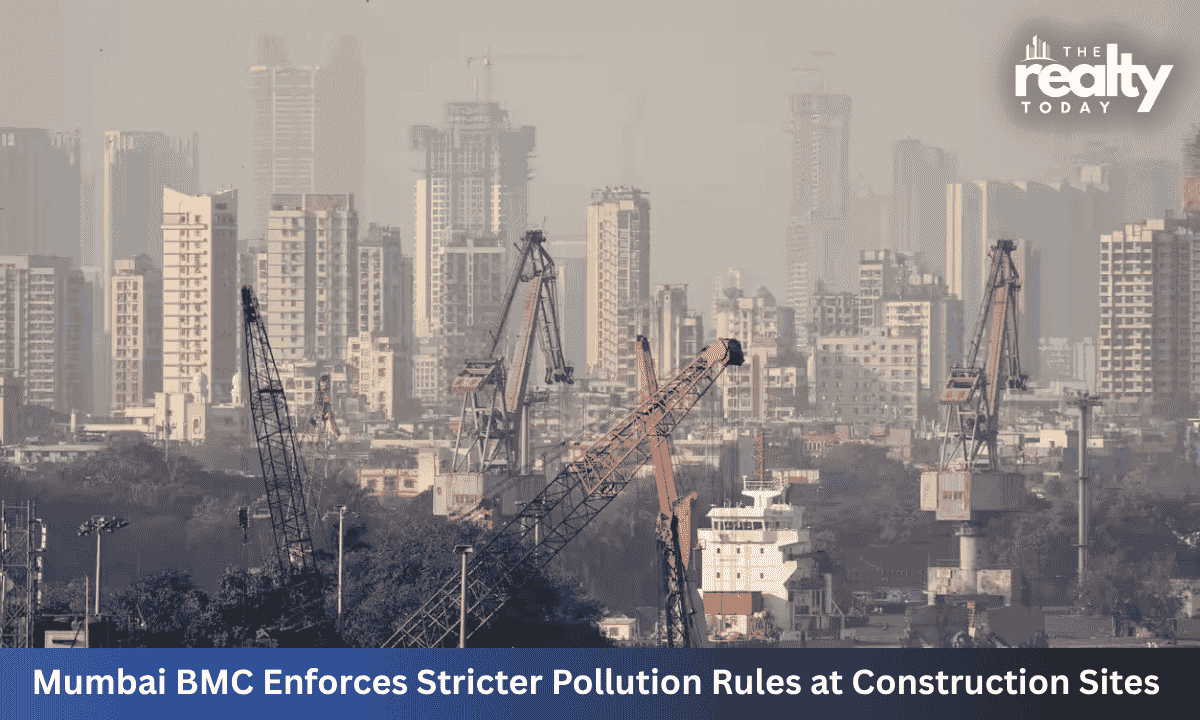
Mumbai’s worsening air quality has brought construction and redevelopment projects under closer watch from the Brihanmumbai Municipal Corporation (BMC). Dust from excavation, demolition, transport of debris, material handling and vehicles at work sites can add to particulate pollution, prompting the civic body to strengthen monitoring and enforce pollution-control requirements.
The Air Quality Index (AQI) indicates how polluted the air is and the related health risk. Under Central Pollution Control Board categories, an AQI of 0–50 is “good,” 201–300 is “poor,” 301–400 is “very poor,” and 401–500 is “severe.” Mumbai’s AQI rose from 92 in 2019 to 125 in 2022, according to data cited from Praja Foundation, and the city has recorded readings above 300 and 400 on several occasions in the past two years.
Rules for Construction Sites
Mumbai’s BMC requires construction and redevelopment sites to control dust and emissions, especially during periods of poor air quality. The rules focus on preventing pollution from excavation, demolition, vehicle movement, debris transport and handling of construction materials.
Mandatory AQI monitoring: Construction sites must install real-time air-quality monitoring sensors to track pollution levels at or near the project location.
Dust-control compliance: Builders must follow BMC’s 28-point guidelines designed to reduce dust and other construction-related pollution.
Water sprinkling: Developers are expected to use water sprinkling and similar dust-suppression measures where activities such as excavation, demolition or material movement create airborne dust.
Control of demolition and excavation dust: Work involving digging, demolition and earthmoving must be managed carefully because these activities are major sources of particulate matter.
Safe handling of materials: Construction materials should be handled in a way that prevents dust from spreading beyond the project site.
Debris transport management: Transporting construction waste and debris must be controlled to limit dust emissions on surrounding roads and in nearby neighbourhoods.
Vehicle-emission and movement control: Heavy vehicles operating at the site can contribute to pollution through exhaust and road dust, so site operations are subject to monitoring.
Inspections by flying squads: BMC has deployed ward-level inspection teams, or flying squads, to check whether construction sites are following the prescribed pollution-control measures.
Notices for violations: Builders found violating the norms can receive compliance notices requiring them to correct the problem.
Possible work stoppage: BMC can suspend or close construction and industrial activity if pollution-control requirements are not followed or if air-quality conditions become persistently poor.
AQI trigger for stricter action: Under the BMC’s GRAP operating procedure issued in November 2025, Stage IV restrictions may be introduced if the citywide or local AQI remains above 200 for three straight days.
Higher compliance pressure during poor AQI: Since an AQI above 200 falls in the “poor” category, sites face stronger scrutiny when local pollution remains at that level or worsens.
Impact on Real Estate
For developers, compliance measures such as water sprinkling and installing AQI monitors are relatively inexpensive, estimated at roughly 0.1% to 0.3% of total construction costs. However, a work stoppage can increase costs more significantly because delayed activity may affect labour, schedules and project completion timelines.
Poor air quality may also influence some homebuyers, especially those considering properties near factories, industrial zones or power plants. Still, developers cited in the report suggest that seasonal pollution has only a limited effect on local housing demand because relocating from an established neighbourhood is often difficult.