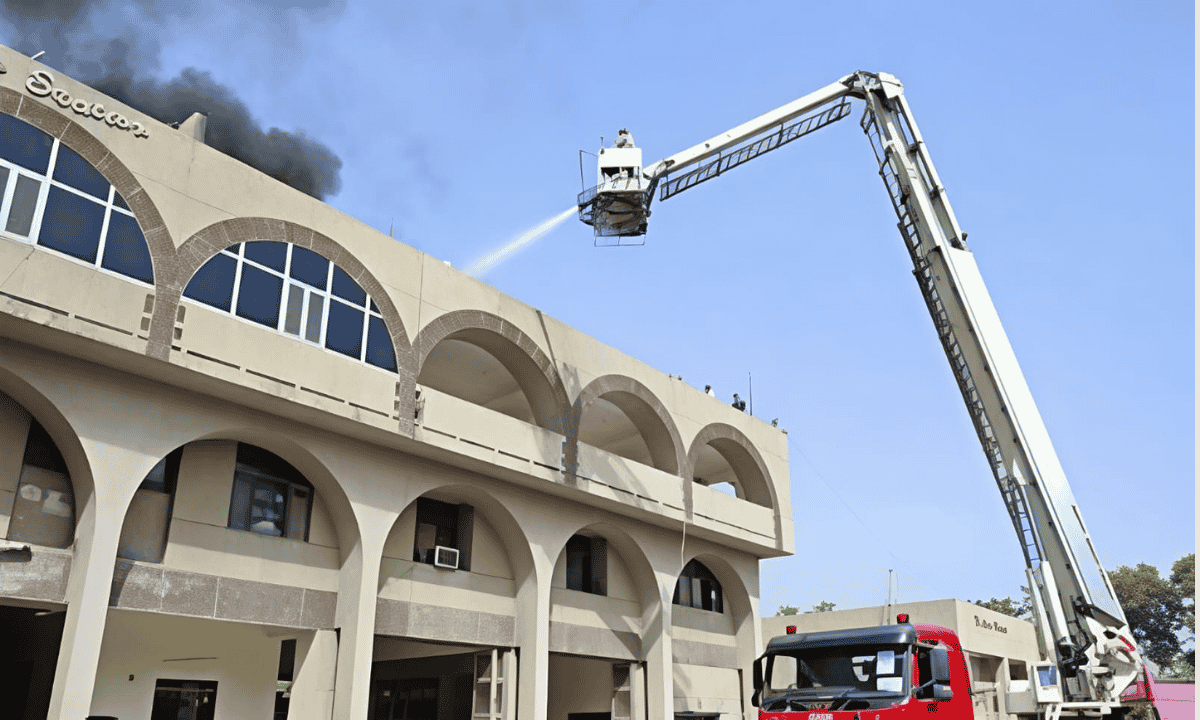

The Maharashtra government has formally acquired the iconic Air India building, a defining feature of the south Mumbai skyline known for its prime sea-facing location, for Rs 1,601 crore. The transfer of agreements between Air India Assets Holding Company and the state Public Works Department was completed in the presence of Chief Minister Devendra Fadnavis at the state secretariat Mantralaya following a cabinet meeting on Tuesday.
The transfer agreement was signed in the Cabinet Hall at Mantralaya. PWD Minister Shivendrasinh Bhosale was present during the ownership transfer and confirmed that the state government had taken formal possession of the building from AIAHL.
This moment, understated by the quiet paperwork of a government agreement, closes a chapter that has been years in the making and marks the beginning of a significant transformation for one of Mumbai's most recognisable addresses.
THE BUILDING: 52 YEARS OF HISTORY ON THE ARABIAN SEA
To understand why this acquisition matters, it helps to understand what the Air India building is and what it has meant to the city.
The Air India building at Nariman Point, crowning the Queen's Necklace, was built in 1974 on reclaimed land leased by the Maharashtra government to Air India. It was designed by American architect John Burgee, who also designed several of the world's most iconic postmodern skyscrapers.
The building stands 105 metres tall, spans 23 floors, and covers a total floor area of 220,000 square feet, with at least 10,800 square feet of space on each floor.
It was the first building in India to feature an escalator, drawing crowds in its early years simply for the novelty of the experience. For a generation of Mumbaikars, a visit to the Air India building was itself an event, a glimpse of a modern, aspirational India taking shape.
A sea-facing tower with the airline's iconic centaur logo crowning it, the building once projected the glamour of India's national carrier. It housed not just Air India's corporate operations but also government offices, banks, and private tenants across its floors, making it less a single-purpose building and more a vertical neighbourhood in the heart of South Mumbai's business district.
It survived a bombing. The building was one of the targets of the 1993 Bombay bombings. A car bomb exploded in the afternoon on March 12, 1993 in the basement garage of the building. Twenty people were killed in the attack and the offices of the Bank of Oman located above the garage were destroyed. In 2007, Farooq Pawale was convicted and sentenced to death for planting the bomb. The building stood. It has stood ever since.
HOW THE BUILDING ENDED UP FOR SALE
In 2013, the debt-laden airline shifted its headquarters from Mumbai to Delhi NCR as part of a wider restructuring and asset monetisation exercise. Air India vacated large portions of the Nariman Point building and began leasing space to other entities.
Air India decided to sell the building in 2018 as part of an asset monetisation plan after shifting its headquarters to New Delhi.
When Air India was privatised and acquired by the Tata Group, the airline itself transferred to new ownership. But the building did not go with it. It was not part of the Tata Group's acquisition of Air India when the airline was privatised. Instead, it remained with AIAHL, the government-owned special purpose vehicle created in 2019 to hold several of Air India's non-core assets and liabilities. That separation meant the building had to be dealt with through a government-to-government process.
THE FIVE-YEAR NEGOTIATION
The road from sale announcement to formal handover was neither quick nor simple.

The Maharashtra government, which had been in talks for the property since at least 2021, was among the bidders when Air India sought Rs 2,000 crore for the building. The state had initially offered Rs 1,400 crore, while the Jawaharlal Nehru Port Authority offered Rs 1,375 crore and the Life Insurance Corporation of India offered Rs 1,200 crore.
Maharashtra eventually won the bid. The state cabinet approved the purchase in November 2023 for Rs 1,601 crore, while also waiving approximately Rs 298 crore in unrealised income and interest dues linked to the property. The Centre subsequently granted final approval for the transfer in March 2024.
The deal moved closer to completion in April this year when the Finance Department transferred Rs 1,600 crore to the Public Works Department for finalising agreements. The formal signing on June 2, 2026 completed the transaction that had been years in the making.
WHY MAHARASHTRA WANTED IT
The answer is straightforward: the state government has been running out of room.
The state plans to shift several of its departments to the building, many of which currently operate from rented premises across Mumbai. With the acquisition, the government will gain around 46,470 square metres of office space close to the state secretariat. This is expected to reduce rental expenditure, bring departments closer to Mantralaya, and improve administrative coordination.
A new annexe to Mantralaya is expected to be ready by September 2026 and will house the offices of the Chief Minister and other ministers. But this too will not be enough. The Air India building fills a critical gap, offering a large, already-standing structure at a prime location that the state does not need to build from scratch.
In essence, buying this building is cheaper in the long run than continuing to pay rent for scattered offices across the city while also lacking the cohesion that comes from departments being in physical proximity to each other.
WHAT HAPPENS NEXT
Possession does not mean immediate occupation. The building is more than 50 years old and requires work before government departments can move in.
At a review meeting held after the handover, PWD Minister Bhosale directed officials to conduct a comprehensive structural audit of the building before any government offices are shifted there. He stressed that interior renovation and other development works should begin only after structural safety concerns are addressed. All repair and refurbishment work should be completed to a high standard, he said.
The minister further directed that the building's main entrance and public areas be redesigned to reflect Maharashtra's cultural and architectural identity, and suggested seeking guidance from leading architects and expert institutions.
The PWD plans to carry out internal renovation and make the building ready for use within a year.
THE BROADER SIGNIFICANCE
This acquisition is more than a real estate transaction. It is the state government formally reclaiming a building that was originally built on land it had leased out, at a location steps away from its own secretariat, after more than a decade of the property being in institutional limbo.
The Air India building stood through India's aviation golden age, through the airline's decline, through its privatisation, and through the unwinding of its assets. For five decades it has faced the Arabian Sea, watched Marine Drive light up at night, and endured one of India's worst terror attacks.
It now passes from the hands of a defunct government entity into those of the state that originally gave the land for it to stand on. The centaur logo that once crowned its roof is gone. The government of Maharashtra is moving in.