

The Karnataka government has unveiled an ambitious plan to position Mysuru as the state’s second major IT hub after Bengaluru, as part of its 2026–27 state budget aimed at expanding the technology ecosystem beyond the capital.
Presenting the budget, Chief Minister Siddaramaiah announced that "Mysuru would be developed as Karnataka’s “second IT city” to help decongest Bengaluru and promote balanced regional growth". The move comes as Bengaluru continues to face mounting pressure on infrastructure due to rapid expansion of the technology industry.
A Strategy to Ease Bengaluru’s Tech Congestion
Over the past two decades, Bengaluru has emerged as India’s leading technology hub, attracting global IT firms, startups and multinational companies. However, the city’s rapid growth has also led to rising congestion, soaring real estate prices and infrastructure strain.
The Karnataka government now aims to replicate parts of Bengaluru’s technology ecosystem in Mysuru, a historic city located about 150 km away, to distribute growth more evenly across the state.
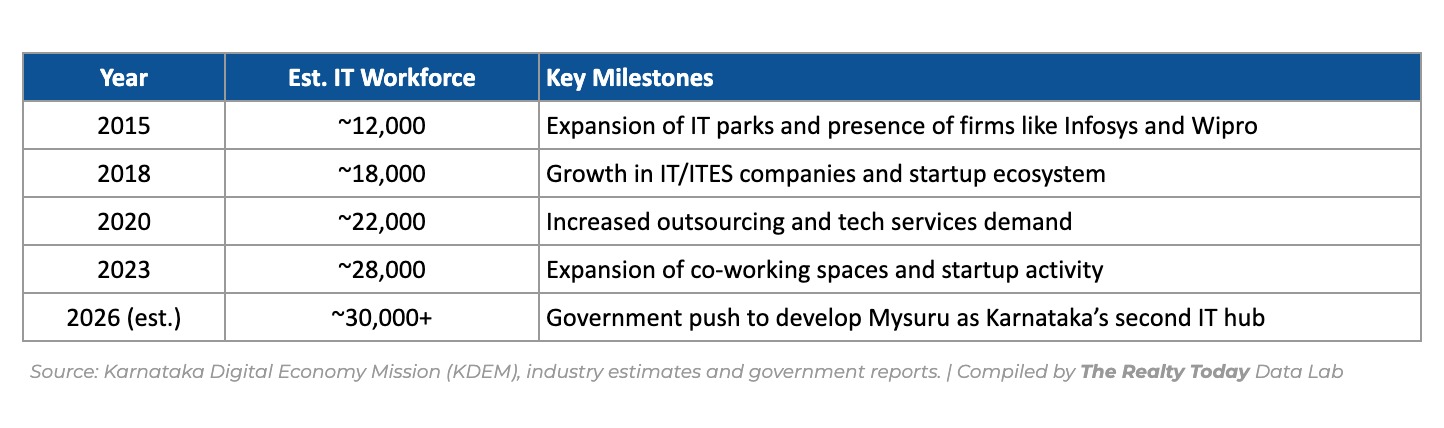
Officials say that more than 30,000 professionals already work in the IT sector in Mysuru across nearly 100 companies, indicating the city already has a base for further expansion.
Growth of IT Workforce in Mysuru (2015–2026)
infrastructure and Industrial Projects Planned
The state budget outlines several initiatives intended to strengthen Mysuru’s economic ecosystem and make it more attractive for technology companies and investors.
Key proposals include:
● Development of tourism and infrastructure projects including lake rejuvenation and park upgrades
● Plans for a Film City and Silk Park, aimed at boosting creative and textile industries in the region
These initiatives are expected to complement the growth of the IT sector by strengthening healthcare, tourism and industrial infrastructure in the region.
A Growing Technology Ecosystem
Mysuru has gradually been gaining traction as an emerging technology destination, thanks to its relatively lower cost of living, availability of skilled talent and improved connectivity with Bengaluru.
Bengaluru vs Mysuru: IT Growth & Real Estate Cost Comparison (2026):
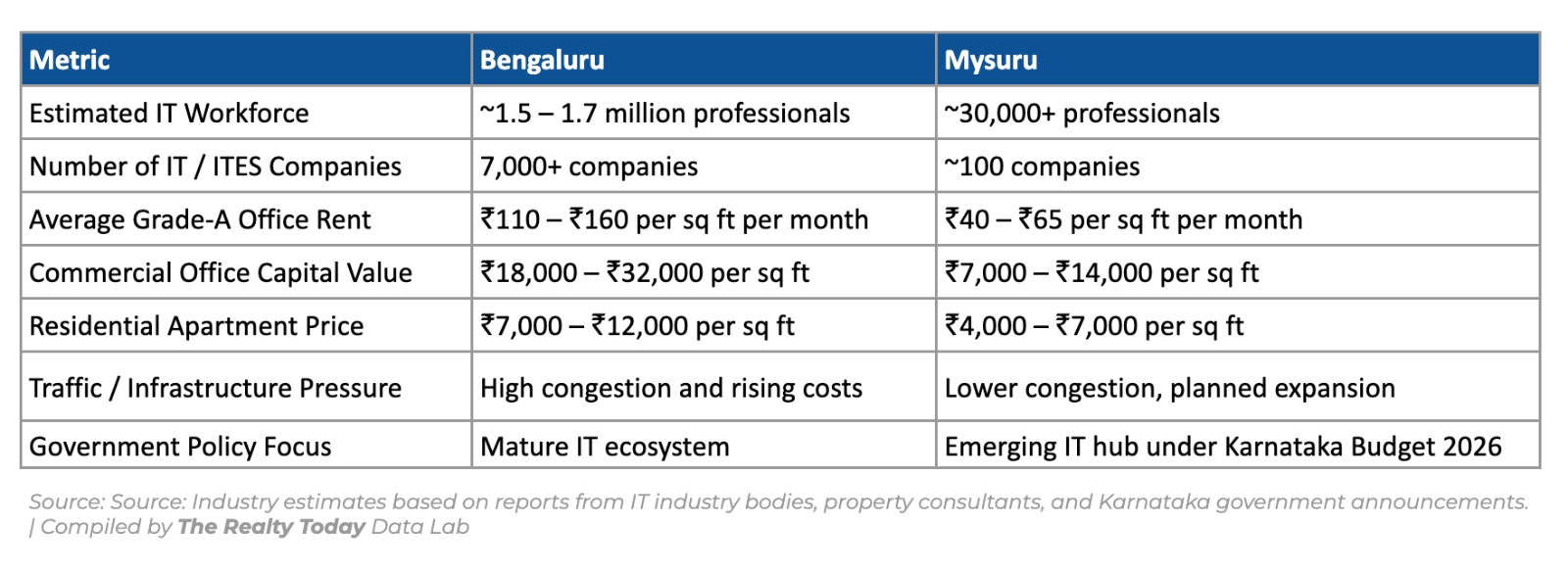
The state government has also been offering incentives under its IT Policy 2025–30 to encourage companies to expand into Tier-2 cities such as Mysuru, Mangaluru and Hubballi-Dharwad. With infrastructure improvements and policy incentives, Mysuru could attract more IT firms looking for cost-effective expansion locations outside Bengaluru’s saturated office market.
What It Means for Real Estate
For the real estate sector, the move could have long-term implications. As technology companies expand operations into Mysuru, demand is expected to rise for commercial office spaces, residential housing and supporting urban infrastructure. Similar patterns were seen in cities such as Hyderabad and Pune, where IT-led growth triggered large-scale real estate development.
Property consultants note that the city’s comparatively lower land prices and planned infrastructure upgrades could make it attractive for both developers and institutional investors over the next decade.
Conclusion
The Karnataka government’s push to develop Mysuru as the state’s second IT city marks a strategic effort to decentralise the technology economy beyond Bengaluru. While the transition will take time, the policy direction signals a long-term vision to transform Mysuru into a major technology and innovation hub.
If executed effectively, the initiative could reshape Karnataka’s regional growth pattern — bringing new opportunities for IT companies, talent, and the real estate sector alike.




.png)