

India’s real estate sector attracted $5.1 billion in capital inflows in Q1 2026, marking a 72% year-on-year jump from $2.9 billion, according to CBRE’s latest market data, setting a new quarterly record for the industry.
Domestic money leads the investment narrative
Domestic investors emerged as the dominant force, accounting for as much as 96% of total inflows, fundamentally altering the capital structure of Indian real estate, which historically relied heavily on foreign institutional capital.
Developers and Real Estate Investment Trusts (REITs) together contributed over 80% of the total investments, indicating that capital is increasingly being deployed by entities with long-term operational visibility rather than short-term financial investors.
This shift reflects a broader trend seen over the past two quarters, where domestic liquidity has steadily replaced volatile global capital amid macroeconomic uncertainty.
Office assets anchor investor confidence
Investment flows in Q1 were led by built-up office assets, followed by continued activity in land and development site acquisitions, underscoring a clear preference for income-generating and scalable platforms.
The office segment continues to offer predictable rental yields and institutional-grade assets, making it the preferred entry point for both domestic capital and REIT structures. Parallel data shows that office leasing touched 20.7 million sq ft in Q1 2026, reinforcing the underlying demand that supports these investments.
Momentum builds on a strong 2025 base
The record Q1 inflows are not an isolated spike but an extension of a strong capital cycle. India’s real estate sector had already recorded $14.3 billion in inflows in 2025, up 25% year-on-year, establishing a high base for continued growth.
Sequentially, Q1 2026 inflows also rose 53% over the previous quarter ($3.3 billion in Q4 2025), indicating accelerating investor confidence rather than a one-off transaction-led surge.
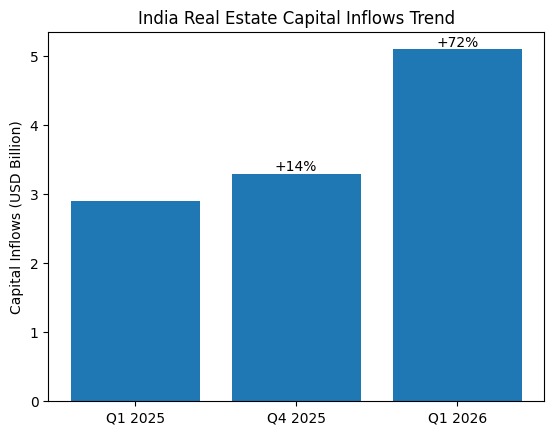
According to CBRE data, India’s real estate sector recorded $5.1 billion in inflows in Q1 2026, up 72% year-on-year
Metro markets capture bulk of capital
Capital deployment remained concentrated in Mumbai, Bengaluru, Delhi-NCR and Hyderabad, where strong occupier demand, infrastructure expansion and institutional-grade assets continue to attract large-ticket investments.
These cities collectively offer the scale, liquidity and exit visibility required by both developers and REIT-backed platforms, reinforcing their dominance in capital allocation cycles.
Real estate emerges as a domestic yield play
The current investment pattern signals a structural repositioning of real estate as a yield-generating asset class backed by domestic capital, rather than a cyclical, globally dependent sector.
With global uncertainty persisting, Indian investors are increasingly viewing real estate, particularly office, logistics and rent-yielding assets as a stable alternative to volatile financial markets.
Outlook
The $5.1 billion inflow milestone marks a decisive shift in India’s real estate evolution, where domestic capital is no longer supplementary but central to growth.
With strong leasing fundamentals, expanding REIT participation and a deepening developer ecosystem, the sector appears positioned to sustain high investment momentum through 2026, driven less by global cycles and more by India’s internal economic strength.






.png)