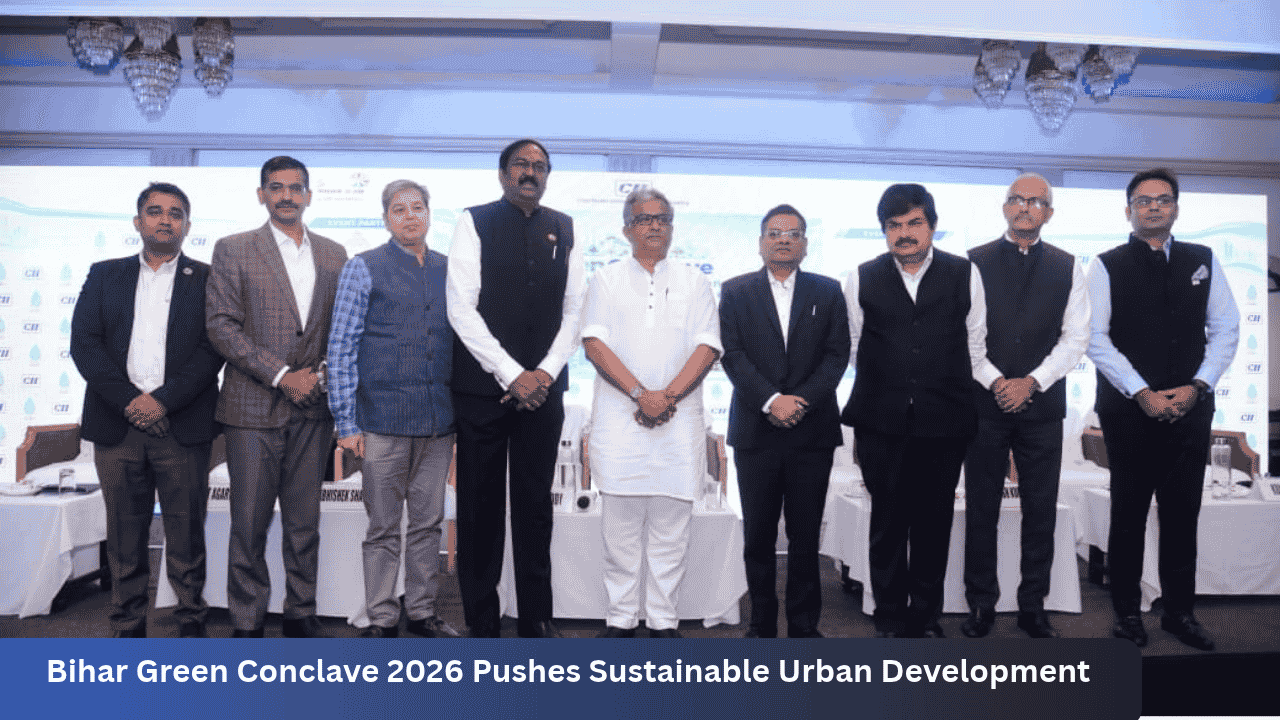
Patna, 4 November 2026: The Confederation of Indian Industry (CII) – Indian Green Building Council (IGBC) organised the 4th edition of Bihar Green Conclave 2026 at Hotel Chanakya, Patna, bringing together senior government officials, industry leaders, urban planners, architects, developers, sustainability experts and other stakeholders to deliberate on accelerating sustainable development across Bihar.
Organised under the theme “Towards a Green Trillion: Sustainable Built Environment for Viksit Bihar,” the conclave underscored the importance of positioning green buildings, resource-efficient industries and climate resilient infrastructure as key drivers of Bihar's economic transformation. The conclave highlighted the immense opportunities for Bihar to integrate sustainability into its rapidly evolving urban and industrial landscape. Discussions focused on energy efficiency, water conservation, green industrial infrastructure, sustainable construction practices, green financing and the adoption of environmentally responsible technologies.
Sustainable Urbanisation Critical to Bihar's Development Vision
Addressing the conclave as Chief Guest, Shri Nitish Mishra, Hon'ble Minister, Urban Development & Housing Department, Government of Bihar, outlined a plan for sustainable township expansion, with 12 satellite townships to ease the pressure on Patna and develop other districts, and a focus on affordable housing. He said all districts will be provided with Urban Local Body master plans and building bylaws to improve ease of living and ease of doing business, with incentives for green buildings, and announced training for Urban Local Body officers. The Minister said the draft Building Bylaws have been sent for Cabinet approval, he highlighted the approved Reuse Water Policy, the proposed amendment to the Municipal Act to simplify approvals, a 15 MW waste-to-energy project in Patna and the incentives for green buildings for wide spreading the green construction practices in the state. He called on all stakeholders to take shared responsibility for the transition and accepted the District Data Portal developed by CII, which carries over 470 indicators and is planned to expand to 1,000.
The conclave highlighted that Bihar's growing demand for housing, commercial spaces, industrial facilities and public infrastructure presented a significant opportunity to adopt green building principles at the planning and design stages. Participants emphasized that integrating energy-efficient building systems, sustainable construction materials, water-efficient technologies, renewable energy and climate-responsive architecture could help reduce long-term operating costs, improve resource productivity and strengthen climate resilience.
Green Industrial Infrastructure to Enhance Bihar's Investment Competitiveness
The conclave discussed how the adoption of green industrial frameworks could support Bihar's efforts to attract investments, improve industrial productivity and create environmentally responsible manufacturing ecosystems. Industry representatives highlighted the potential for sustainable industrial facilities to reduce energy consumption, optimise water utilization, improve waste management and lower operational costs. The discussions also explored the role of green financing in supporting industries transitioning towards low-carbon and resource-efficient operations.
IGBC Reaffirmed Commitment to Accelerating Green Building Adoption in Bihar
Addressing the gathering, Mr C Shekar Reddy, National Chairman, CII Indian Green Building Council, highlighted the critical role of green buildings in supporting Bihar's sustainable development ambitions. He emphasized that green buildings offered multiple benefits, including reduced energy consumption, lower water demand, improved indoor environmental quality, enhanced occupant well-being and reduced environmental impact. He noted that India has around 20,000 registered green building projects, with average savings of 20–40% in water and about 30% in energy.
Mr Bhavesh Kumar, Chairman, CREDAI Bihar, called for early notification of the Building Bylaws and a focus on Tier-2 and Tier-3 cities. Mr Gaurav Sah, Chairman, CII Bihar State Council, spoke on extending sustainability across all asset classes including the building and industrial sectors.
The conclave also highlighted the importance of greater awareness, capacity building, stakeholder partnerships and supportive policy frameworks to accelerate the adoption of green building practices across Bihar.
IGBC Highlighted Green Building Opportunities and Potential Savings in Bihar
Mr Punit Agarwal, Senior Counsellor, CII–IGBC, showcased an impact analysis of green buildings, highlighting potential savings and opportunities for their wider adoption across Bihar. The programme also featured the induction of Mr Vinay Pruthi as Co Chairman of IGBC Patna in the presence of the minister.
Collective Action Essential for Building a Green and Resilient Bihar
The conclave underscored the need for a collaborative and integrated approach to accelerating Bihar’s green transition, involving government, industry, developers, financial institutions and technology providers. Key priorities included mainstreaming green building practices across all asset classes, promoting energy efficiency and renewable energy, strengthening water conservation and wastewater reuse, developing green industrial infrastructure, improving access to green finance and integrating climate resilience into urban planning.
The 4th Bihar Green Conclave 2026 concluded with a call for stronger stakeholder partnerships and wider adoption of sustainable building and industrial practices, positioning sustainability as a key pillar of Bihar’s economic growth and infrastructure development, in alignment with the national vision of Viksit Bharat 2047.
About CII-Indian Green Building Council
The Indian Green Building Council (IGBC) was established by the Confederation of Indian Industry (CII) in 2001 to actively to promote the Green Building movement in India. The Council, consists of 33 Chapters across India, is represented by all stakeholders of the construction industry, comprising corporate, government, and nodal agencies, architects, product manufacturers, institutions, and more. The Council also works with governments, industry bodies, the World Green Building Council, bilateral and multilateral agencies in promoting green building vision in India.
With a registered Green Building footprint of over 16.48 billion Sq. ft. and 20,450 registered projects adopting IGBC’s 33 Green and Net Zero rating systems, the Green Building movement in India has been advancing at a rapid pace and transforming India into one of the global leaders in green built environment. IGBC is a market leader with about 90% of India’s green building projects adopting IGBC Green and Net Zero Rating Systems.