

If your tenancy is up for renewal and you live, work, or run a business in Abu Dhabi — your rent stays exactly where it is. Your landlord cannot add a single dirham to what you paid last year. That is the law as of June 2, 2026.
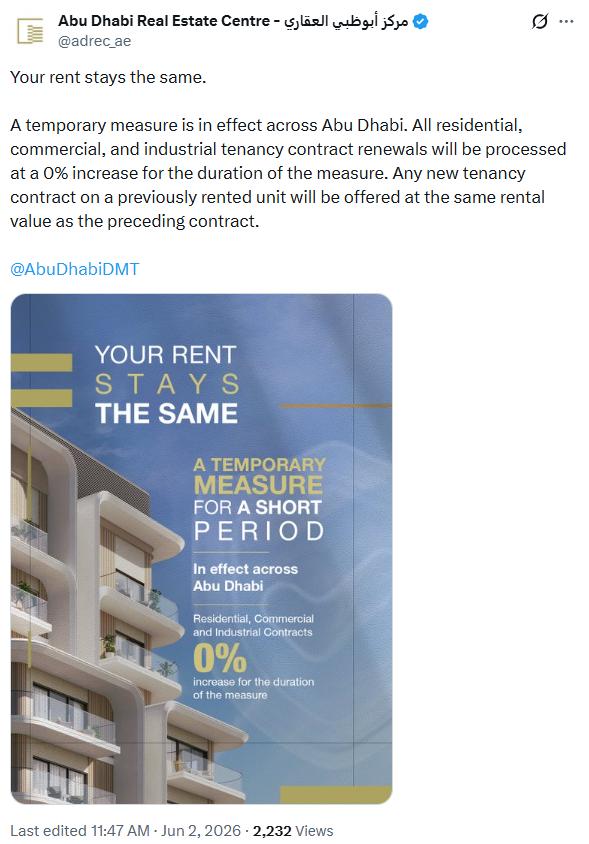
The Abu Dhabi Real Estate Centre (ADREC), the body that oversees property in the emirate, made the announcement on Tuesday via a post on X. Short, direct and immediate: "Your rent stays the same."

Why now?
Abu Dhabi's rental market has been one of the tightest in the Gulf for the past few years. Demand has consistently outstripped supply, occupancy rates have hit record highs and new lease prices have surged. On top of that, the ongoing US-Iran conflict in the region has pushed up fuel prices, triggered job losses, and squeezed household budgets across the UAE. The government decided it could not let rents move freely in that environment.
Under the rule that existed before this week, landlords could raise rent by up to 5% at every annual renewal as long as they gave tenants two months' notice. That rule has now been suspended entirely. Every renewal, and every new contract on a previously rented unit, must go through at the same rent as the last registered contract.
"This is giving more muscle to the tenants to dictate a better price for themselves. It's great news for tenants."
— Mario Volpi, senior manager, Eva Real Estate (The National)
Rents had been climbing far past the 5% cap anyway

Who benefits most?
Everyone renewing a tenancy in Abu Dhabi right now. That includes families in apartments, shop owners, warehouse operators, and office tenants. Indians — who make up over 35% of the UAE's population — are among the biggest beneficiaries, given how many Indian expat households face annual rent hikes at renewal.
For landlords and property investors, the picture is less comfortable in the short run. Those who were counting on 5% rental growth this year will not see it. But property experts note that capital values in Abu Dhabi are still expected to rise 15-16% in 2026 — so long-term investors are not in a panic.
"The freeze caps near-term rental upsides and moderates immediate ROI — countering a new rental index that had forecast 25-30% hikes in certain zones."
— Pyush Lohia, MD, Lohia Worldspace (land2capital)
Abu Dhabi vs Dubai — two very different systems
Dubai has not announced any rent freeze, and experts say it is unlikely to. The two emirates have run different rental systems for years, and they remain far apart in how they handle landlord-tenant rules.

Dubai's RERA Smart Index — launched in January 2025 — calculates how much a landlord can raise rent based on how far the current rent sits below the market average. If a tenant is already paying market rate, no increase is allowed. If they are well below it, a tiered increase kicks in. It is a more complex system, but also more market-responsive than Abu Dhabi's flat-cap approach.
Dubai rents by area (2025) — where they moved most

Two things to know before you act
Firstly the freeze is not retroactive. If your landlord raised your rent and you registered the new contract before June 2, that increase stands. The freeze only covers renewals from June 2 onwards.
Second is ADGM, the financial free zone on Al Maryah Island, is exempt. It operates under a separate legal framework and the rent freeze does not apply there.
For everyone else in Abu Dhabi if you believe your landlord is not following the directive, ADREC has set up a dedicated complaint channel at adrec.gov.ae.