

India’s REIT Market Surges: Key Highlights and Implications for Real Estate
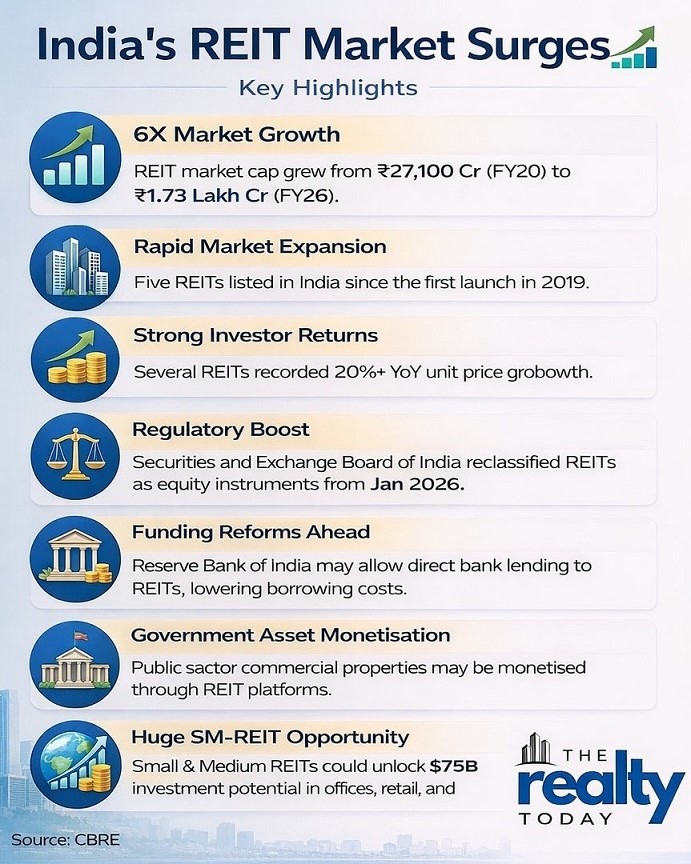
- India’s REIT market cap grew sixfold, from ₹27,100 crore (FY20) to ₹1.73 lakh crore (FY26).
- Growth driven by institutional investor participation and confidence in stable returns.
- Five REITs now listed since India’s first REIT in 2019.
- Several REITs saw >20% YoY unit price growth.
- SEBI reclassifying REITs as equity instruments (Jan 2026) may boost investments.
- RBI may allow direct bank lending to REITs, reducing borrowing costs.
- Government plans to monetise public sector real estate via REITs.
- SM-REITs could unlock $75B investment potential in offices, logistics, retail.
The Indian real estate investment market is undergoing a major shift. Real Estate Investment Trusts are growing fast. Market capitalization of these trusts has increased more than sixfold. It rose from Rs 27,100 crore in fiscal year 2020 to Rs 1.73 lakh crore in the first nine months of fiscal year 2026. A recent CBRE report shows these numbers. Institutional investors are stepping up their involvement. More funds are flowing into REITs every month. This trend is likely to keep expanding. REITs will become a top choice for long-term property investments. The sector's growth is expected to accelerate in the coming years.
Rapid Growth Since the First Listing
India’s REIT journey began in 2019 with the listing of the country’s first REIT. Since then, the market has evolved rapidly, attracting both domestic and global investors.
Several factors have contributed to this strong growth trajectory. These include the listing of new REIT platforms, rising unit prices of existing REITs, and increasing interest from institutional investors looking for stable income-generating assets.
Currently, five REITs are listed on Indian stock exchanges, including Knowledge Realty Trust, which debuted in August 2025. The other listed REITs have also demonstrated strong market performance.
Key highlights of the REIT market expansion include:
- Market capitalisation increased more than six times between FY20 and FY26
- Total REIT market cap reached ₹1.73 lakh crore
- Four existing REITs recorded over 20% year-on-year unit price growth
- Institutional investor participation has increased steadily
- More high-quality commercial assets are being monetised through REIT structures
The rapid rise in market capitalization indicates that REITs are becoming an increasingly attractive option for investors seeking stable returns from real estate without directly owning property.
Regulatory Changes Supporting Growth
Regulatory reforms are playing a critical role in shaping the future of India’s REIT market. Several policy changes are expected to accelerate the sector’s expansion and broaden investor participation.
One of the most significant developments is the decision by the Securities and Exchange Board of India to reclassify REITs as equity-related instruments starting January 1, 2026.
This move is expected to unlock new investment flows into the sector.
- Key implications of this regulatory change include:
- Mutual funds may increase allocations to REIT instruments
- Specialised investment funds will face fewer restrictions
- Hybrid investment limits that previously constrained REIT exposure will be relaxed
- Market liquidity could improve significantly
By aligning REITs more closely with equity instruments, the regulator aims to integrate them more deeply into mainstream capital markets.
Possible Inclusion in Equity Indices
Another development that could boost the REIT market is the expected inclusion of REITs in broader equity indices.
Industry experts anticipate that REITs could be added to major indices around July 2026. If implemented, this move would likely attract significant passive investment flows.
Potential benefits of index inclusion include:
- Increased participation from index funds and ETFs
- Greater liquidity in REIT trading
- Improved price discovery in the market
- Enhanced visibility among retail investors
- Increased institutional confidence
Index inclusion has historically boosted investor participation in several emerging asset classes, and REITs could follow a similar path.
RBI plan may reduce loan expenses
When it comes to funding, tweaks in rules might boost how REITs operate. A different approach here could quietly reshape outcomes down the line
Right now, most REIT platforms get their loans through bond markets. A shift might come soon - the Reserve Bank of India is looking into letting regular banks offer credit straight to REITs. This shift might lower what lenders charge when REIT leaders seek funds, while also opening up different ways to secure capital if put into practice.
Expected advantages of direct bank lending include: Reduced borrowing expenses for real estate investment trusts
- Greater access to credit markets Reduced dependence on bond issuances
- Improved capital structure flexibility More Profitable REIT Portfolios
One step ahead, REIT funding rules could mirror what InvITs already enjoy, leveling the playing field slowly but surely. While different on paper, both trusts might operate under similar conditions if changes take hold. Not sudden, not flashy - just steady shifts that adjust how capital flows into real estate and infrastructure alike.
Government Push Through Asset Monetisation
The government is also exploring new ways to expand the REIT market through asset monetisation.
In the Union Budget 2026–27, the government proposed creating dedicated REIT structures to monetise commercial real estate owned by central public sector enterprises.
This initiative is expected to unlock large volumes of institutional-grade assets and bring them into the REIT ecosystem.
Key objectives of this proposal include:
Monetising underutilised commercial real estate assets
- Increasing transparency in government-owned property management
- Attracting institutional investors to public assets
- Generating long-term revenue for public sector enterprises
- Expanding the overall supply of REIT-ready properties
The Growing Potential of SM REITs
The small and medium-sized REITs are gaining ground, opening doors to fresh corners of property markets. With time, these outfits could pull in more players, shifting how access spreads across the board.
CBRE figures suggest the chance for small and midsize REITs in India might go beyond 75 billion dollars. Fueled by a steady stream of potential property deals, the expansion gains traction. Buildings already operating in the market sit ready for shift into REIT frameworks. Movement forward hinges on these active income-producing sites turning into share-based holdings. A deep roster of such opportunities keeps momentum alive. Each conversion possibility adds weight to the overall climb.
- Potential assets for SM REIT platforms Office buildings in emerging business districts
- Logistics and warehousing parks Retail commercial spaces
- Grade-A office campuses Technology parks in growing cities
Experts say more than 500 million square feet of office space might work for these kinds of buildings. Although exact numbers vary, the potential is spread across many cities. Where older offices sit empty, conversion becomes a possibility instead of demolition. Space once used for business may now house people because needs have shifted slowly. Not every building fits, yet enough do to make a difference over time.
A fresh path opens when small builders tap into big funding through SM REITs. These structures let local landlords reach deeper pools of money. Instead of relying on traditional loans, they might draw interest from long-term investors. That shift can widen the playing field across India's property landscape. More players join, not just a few dominant names. Over time, the market breathes easier with varied participation.
A New Chapter for Property Investing in India
Nowhere else has seen such quick expansion in property investment trusts like India. Ownership patterns in office spaces are changing because of it. Financing methods have shifted quietly but deeply across cities. What once stayed within private hands now moves through public markets instead.
Now there are regulated options beyond old-school real estate investing. These let people tap into top-tier properties that earn steady returns. Not everyone sticks to buying buildings outright anymore. Fueled by shifting demands, the industry looks set to climb higher soon. Momentum builds as new players enter the space quietly. Behind the scenes, updates in technology help push things forward. Customer interest stays steady, even amid broader changes. What happens next depends on how rules evolve across regions
- Increasing institutional investment in real estate Regulatory reforms improving market accessibility
- Expansion of commercial office and logistics infrastructure Growing demand for stable yield-based investments
Rising interest from global investors With additional properties moving into REIT frameworks, while regulations gradually adapt, the role of REITs in India may grow quietly dominant within real estate financing. What begins as a narrow channel might just reshape how buildings are funded across cities.
A chance opens up for investors, developers, and those shaping policy - one that taps into value while sharpening clarity across India's property landscape. Financial depth grows quietly within this space, reshaping how buildings and land are seen handled drawn out over time.