

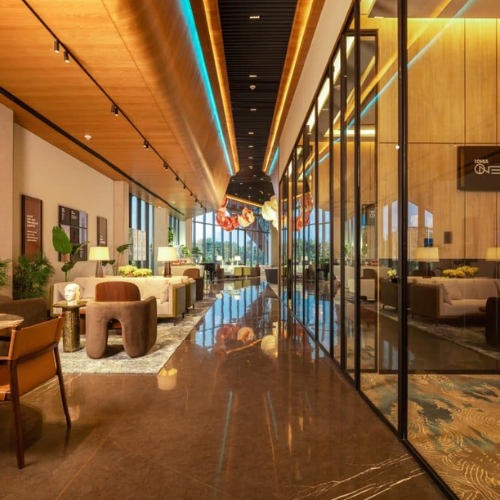
As the first of its kind for Lohia World Space in New Moradabad, TOD Design Innovation's 7,000 sq ft experience centre transforms the conventional sales gallery for property into an immersive story-telling environment. The centre adds a new dimension to the real estate sales process by creating an experience that illustrates the company’s identity, beliefs, and aspirations through the integration of form, light and spatial storytelling techniques.
The original mandate was for the building to be a strong marker in terms of Urban Development, which allows the building to help give a strong visual and symbolic presence for Lohia One to the city of Moradabad within the context of the evolving Urban Fabric of Moradabad. While the brief for the building included two distinct programs that needed to coexist; that of a public-facing sales gallery and private operational offices for the Lohia Group; the main challenge was in determining how best to create an architecture that provides an experience that is both Iconic and Statement-making, yet simultaneously contextually rooted within the Location of the Building, thus establishing it as a relevant urban artefact not only as a design object but also as a meaningful contribution to the Urban Environment.
Reimagining Craft through Parametric Design
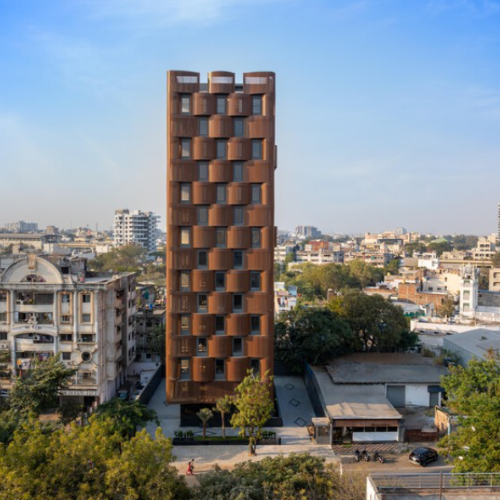
At the center of this ndeavor is a modern parametric architectural language fed with cultural nods from their region of origin. One of the significant cultural icons in Moradabad is its historical background in brass craftsmanship, which easily influenced the design of this building rather than imitating it. Instead of mirroring their motifs, they abstracted the concept of their crafts through a jali-inspired facade of their building.
This reinterpretation enables a seamless integration of tradition and technology. This skin is now utilized purely as a function of form, rather than surface decoration, integrating cultural significance into structure by incorporating it directly into the geometry of the building. Craft is integrated into geometry and precision to provide authenticity within a modern context.
Architecture in Motion
Behind the formal language, the philosophy of balance and movement is at play," the firm says. "Rising, sloping geometries resist a smooth, calm quality in favor of non-parallel facade lines, implying a movement that is at the same time experienced, not just observed. As the visitor traverses the building, varying views, optical illusions, and views layered with movement lead to a spatial narrative that is experienced progressively.
The experience center is meant to engage customers' emotions and turn purchasing into an experience rather than just an act of buying. It uses depth, perspective, and compression and expansion of space to engage customers and make it clear that the building is an ambassador for its brand and an iconic structure within its landscape.
Form Resulting from Site Constraints
The triangular plot contributed largely to the designing process due to the architecture requirements. Instead of working against the constraints that the plot poses, the designing process embraces the same and results in the creation of the boomerang-shaped building that is visible from the major road. This is a move that ensures the building will have several faces that will boost its identification.
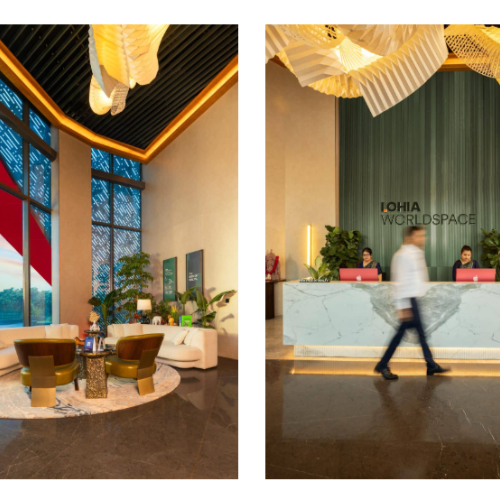
On the programming level, the development is divided into two distinct zones. The sales galleries are very open in terms of the way they respond to the public domain, welcoming people into the space, while the private office areas are more highly regulated and self-contained. There is a pronounced change in the volume of the building, which goes from being 3.5 metres wide at the edges to seven metres high at the entrance. There are differences in the ceiling heights inside.
Overcoming Design and Execution Challenges
The challenge of incorporating intricate parametric designs into feasible and economical structures was difficult. The non-orthogonal shape of the land required careful considerations to facilitate intuitive flow and unobstructed visibility. The process required coordination with fabricators to ensure that the generated shapes of differing complexities from digital modeling had not been distorted.
Equally important was incorporating local craft references in a way that was relevant today. The design team was also mindful of not simply applying external decoration and ensuring that cultural references were subtle and embedded strongly within architectural language.
Strctural Elements
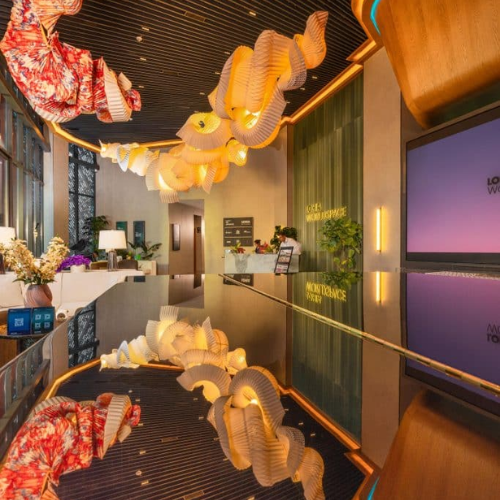
The structural system is of steel, designed to provide clean spans to house this sculptural architectural form. The facade features CNC-cut aluminum or composite material panels that are carefully perforated to match 'jali' motifs but retain an elegant, modern aesthetic.
Light panels, glasses, and metal strips are incorporated to reinforce lightness and continuity of vision in the building's envelope and interior spaces. These elements aim to draw inspiration from traditional 'jali' windows and set a modern standard for architectural expression in Indian context building designs and buildings.
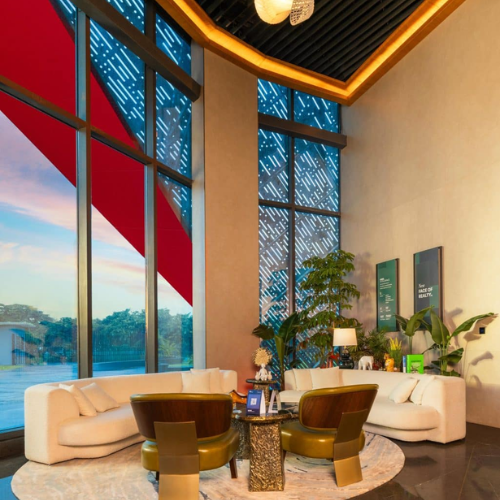
These layered parametric patterns introduce a level of complexity to create a kaleidoscope of light and shadow effects. Also, with the entry of light through these perforations, there are moving patterns on the interior surfaces, which further enhances the experience of this space.
The colour scheme is also very subdued, ranging largely through soft greys, whites, and muted metallic finishes that are more than happy to let geometric patterns be the stars of the show. Brass highlights are judiciously placed to provide a subtle tribute to Moradabad’s material culture.
Architectural and Brand Storytelling.
Multi-faceted Parametric Façade. One architectural feature that creates an experience for the visitor. Achieves a relationship between the cultural dimension of the location, visual stimulation, and recognizable branding. Provides the opportunity for a dynamic performance, which will allow for continued visual impact and iconicity within the surroundings of the building and the reason it will serve as a successful brand-based, identity-based landmark, connected numerically to each location.
The Lohia World Space Experience Centre, as an architectural narrative, represents the transformation of an ordinary sales center into a true experience. It is because of this that Moradabad will elevate its design aspirations, becoming a blank canvas for future growth and development.




.png)