
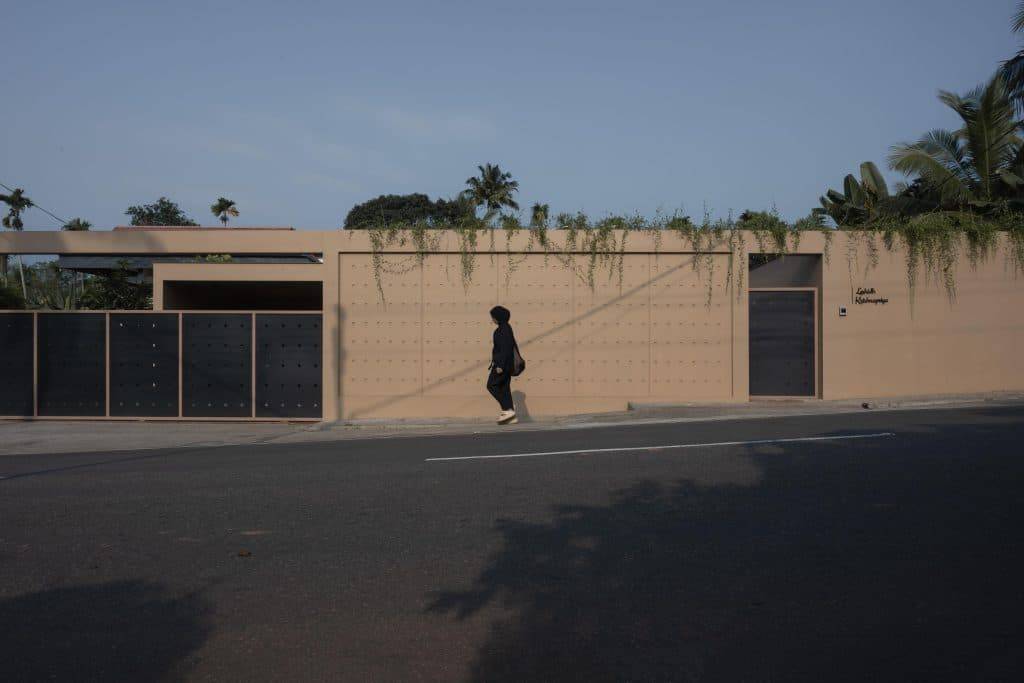
Located along a busy highway in Thrissur, Corridor House 2.0 by i2a Architects Studio tackles the tough environment in a considerate and thoughtful way. Given the nature of this environment, characterized by continuous movement of vehicles, dust, etc., it is understandable what the residents demanded from this dwelling. The dwelling had to be a privatized and quiet place, at the same time not an enclosed one.

The client was an education consultant and required a dwelling that was intimate and serene, far from their working life. This requirement influenced their design right from the inception. This dwelling does not completely exclude the exterior space but instead allows it while maintaining their seclusion.
Walls of Light
The most defining aspect of the house is the boundary wall that fronts the highway,” explains the designer’s statement on the website of the architectural firm that created the design for the house. The wall runs along the front edge of the property and protects it from the highway in terms of noise and dust as well as the visual impact on the house. As soon as one enters the house, the feeling of calm permeates the entire environment.
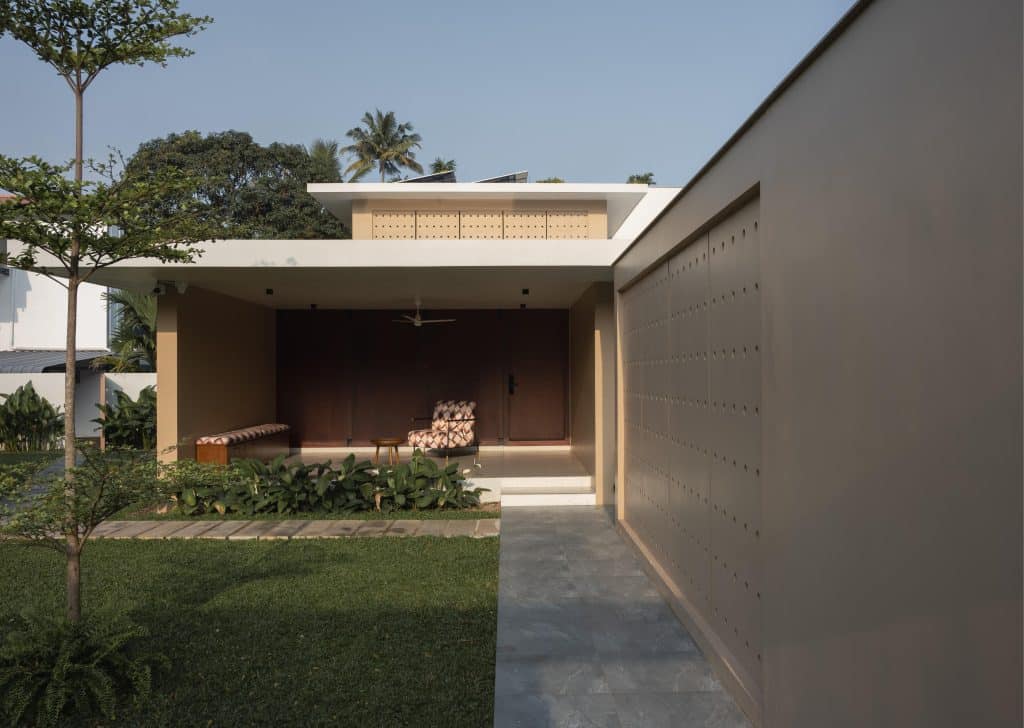
So as to avoid giving an impression of heaviness and closing to the wall surface, round perforations were introduced on it by the architects. Through these perforations, light and air can penetrate and hence alleviate the wall surface. This also brings life and movement to the wall surface as light moves up and down from day to day as a result of sunlight passing through those perforations. The element of perforation is also dominant in this design and is used in various aspects of the design such as façades and doors of the house.
The standout features
The central feature of the house is a corridor that stretches from the entrance of the house up to the end of the land. The corridor is the central organizing feature of the plan. It is more than a passage way; it is the way in which one experiences the house. It links all spaces in a sequence.
Accessing the house is quite simple and humility was maintained through the design. There is a picket gate that opens frontally into the corridor, which sets the mood for the transition process from outside to inside. To the left, there is a pooja court that operates as a courtyard. There is filtered morning sun access through the permeable structure of the pergola.
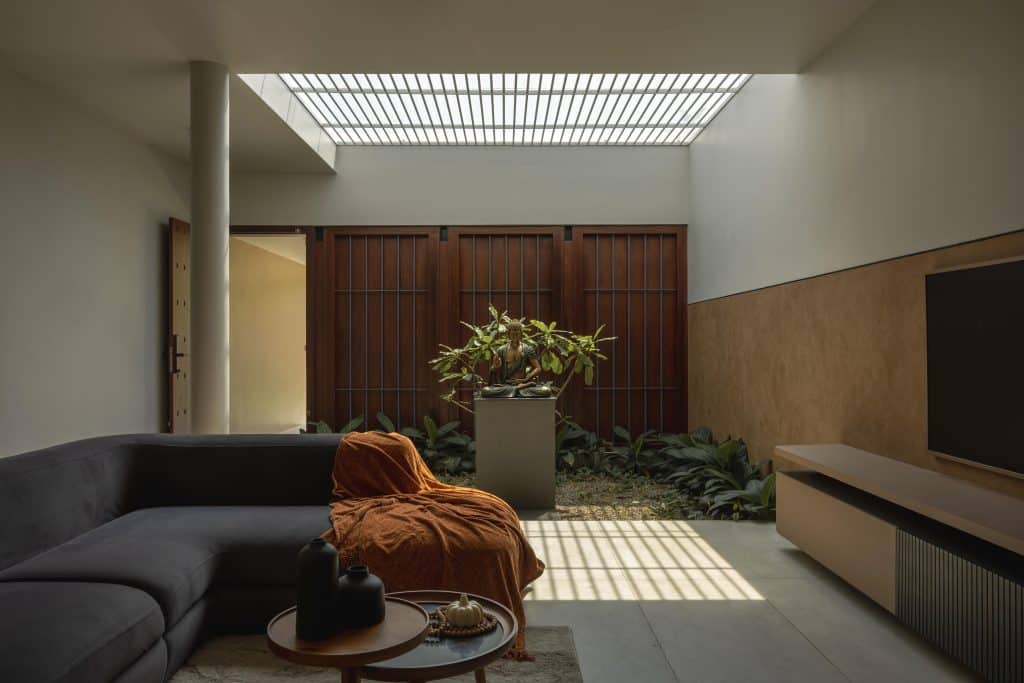
Progressing further, there is a family living room opening to landscape pockets, which ensures a visual link to nature while being safeguarded against the road. The dining area, kitchen, office kitchen, and utility areas are planned in an effective manner on one side of the corridor. The areas are well-connected and receive sunlight while maintaining privacy.
A staircase is provided midway through the corridor that goes to the top floor of the house. Courtyards are provided inside the house on both sides that provide illumination and ventilation to the house. Not only does the courtyard provide ventilation to the house; it helps the house remain naturally illuminated as well.
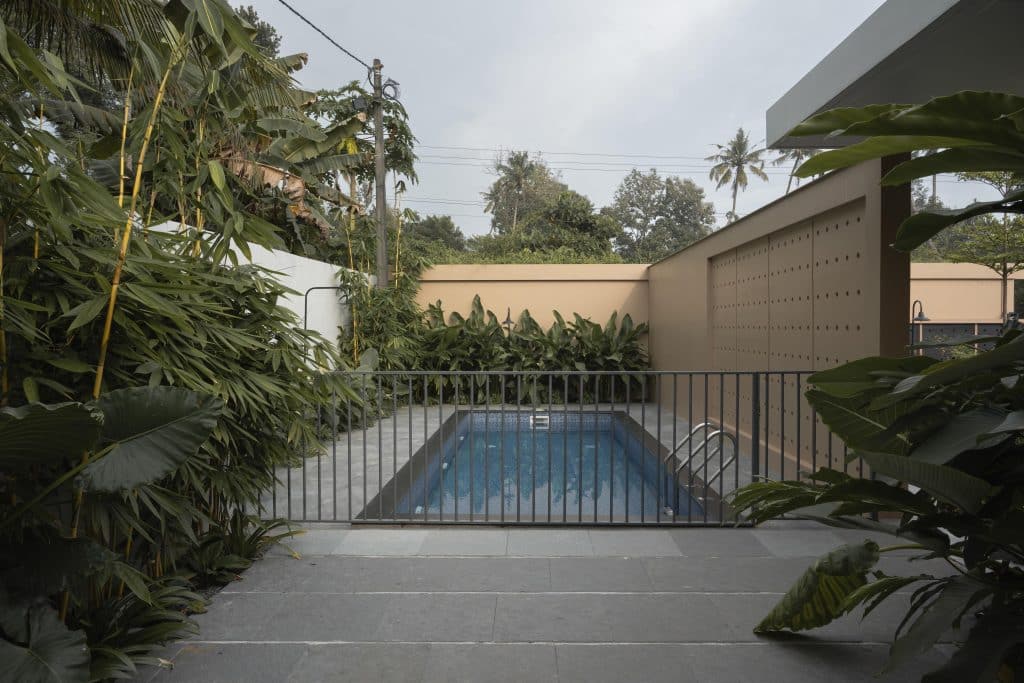
towards the end of the corridor, there are two bedrooms facing the green voids. This is for privacy, ventilation, and sound relief. At the side of the front façade is the swimming pool area. Beyond the aesthetic appreciation, the swimming pool area is a relief for cooling effects around the area. The swimming pool area also disrupts the solid boundary wall of the building.
Quiet balance
Then, the first floor follows the same logic of planning. This floor has a gymnasium and another bedroom, which have been planned for natural illumination and ventilation. There is a planned glimpse of the surroundings from the above floor.
Although the house is surrounded by secure boundaries, it does not appear as though it is closed. The house has most of its rooms directed towards the courtyards or grassy pockets. The house appears open since it maximizes the services offered by nature. Nature can provide air or light.
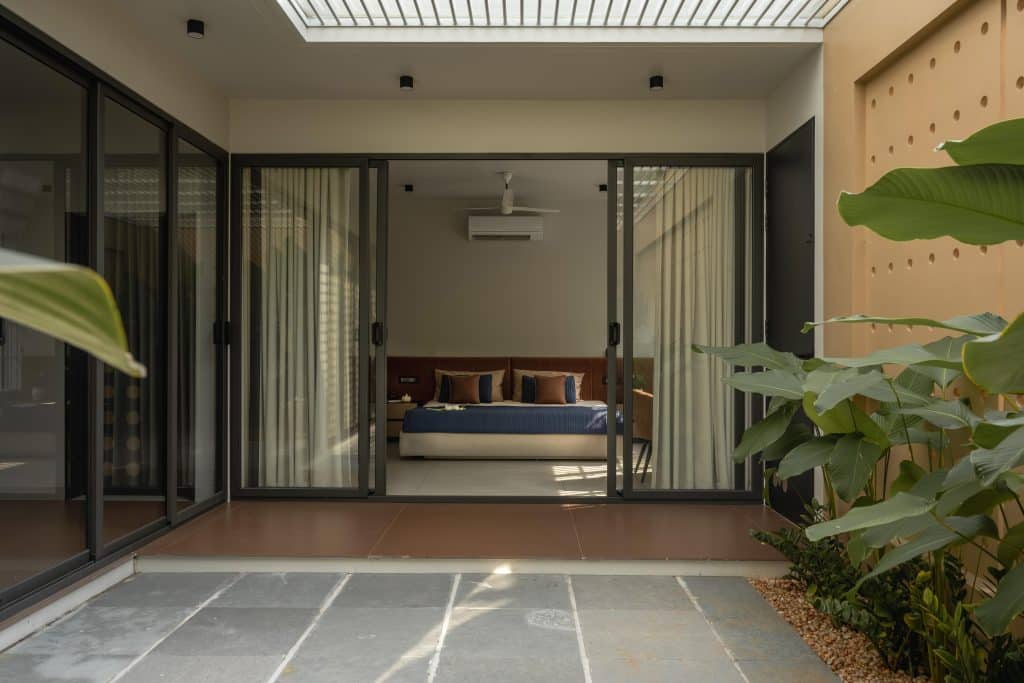
These elements meet the design intent. In terms of materials, there is ochre plaster with a matte finish for exterior and interior walls. This has circular perforations, adding interest to the design of the walls. There are also wooden elements for doors, as well as interior walls, adding warmth without any decorative elements. There are large-format grey stones with a semi-polished finish for pathways as well as functional zones, adding durability. Soffits with white slabs and linear lighting add emphasis to edges, while there are black detailing elements for railings and functional elements. There are landscaping elements with lawns, as well as tropical vegetation, adding elements of nature around the structure, especially on the edges.
The lighting at night emphasizes the perforated boundary wall along the highway. There is no visually dominant perforated boundary wall along the highway.
A Measured Retreat
Corridor House 2.0 can thus be seen as a project where the difficult urban conditions have been addressed without the building being defensive. Corridor House 2.0 provides a good example of a building where openness and enclosure, as well as structure and comfort, have been brought together. The project also shows the client’s demand for clarity and calm.
Instead of blocking out the rest of the city, the design very carefully controls the flow of the outside world into the house. In doing so, it demonstrates that privacy does not have to be about isolation or seclusion for the privacy sphere to be created. Where there is heavy commercial or fast vehicular traffic on the road, the house sets its own pace: quiet and constant.




.png)