

Matharoo Associates, an AD100 firm, has designed this house along a narrow cul-de-sac in Chennai, where the tightly packed houses and urban pressures dictate the usage of every square foot. The residence questions how openness can be attained on a limited site. Visually, the house from the road is a quiet concrete volume, somewhat severe and almost enigmatic in its character. Its external facade barely hints at the luxuriousness of the area inside. Upon arrival, one discovers a multi-faceted interior of the house dominated by courtyards, varying volumes, and the light that has been meticulously brought in.
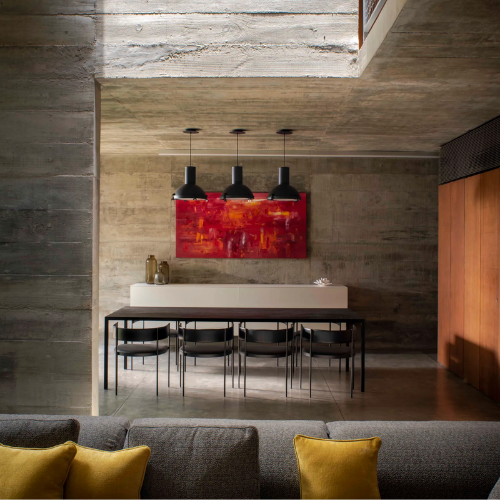
Built on 4,182 square feet of land, the house was the architects' vision of the perfect home for a migrant businessman, his wife, and their three daughters. The land was surrounded by the houses on three sides and a taller apartment building was towering over it on the fourth side. The problems of privacy, ventilation, Vastu alignment, and municipal regulations were all interrelated. The team has avoided a typical inward-looking plan and has designed the interior of the house in a way that the relations between different spaces inside open up. As a result, the house gives a feeling of being spacious although the footprint is quite small.
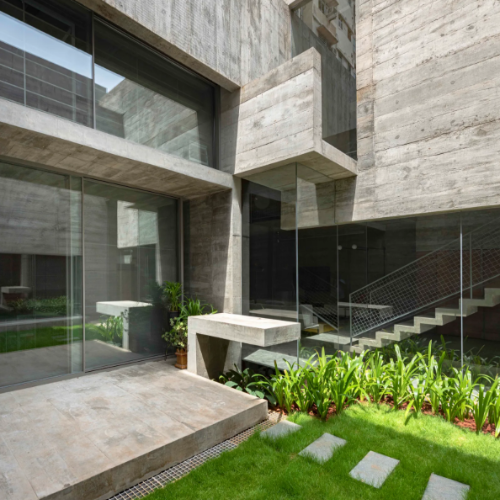
A Protective Envelope with an Open Core
The living quarters integrate a single concrete envelope which complies with the local regulations and goes to the very edges. This outer skin is a shield against noise, heat, and any kind of visual scandal from the neighbourhood. The spaces inside this wrap are revolving around voids open to the sky that draw in fresh air and daylight even to the inner depths of the plan.
The house's essence is the contrast of the dimmed exterior with the radiant interior. The structure is a kind of treasure that slowly unfolds, the rooms not only shocking the visitors with the views but also with the light coming from above and across the site. Consequently, the people experience the feeling of being safe yet free. The family can thus stay connected with the light and the nature without compromising their privacy.
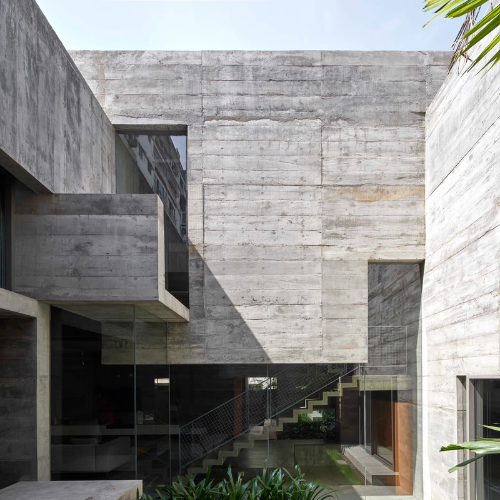
Courtyards as the Spatial Framework
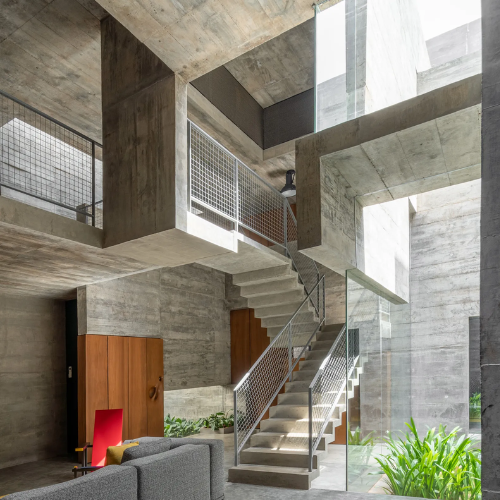
The house has its main courtyard at the centre which is the focal point of the plan and the first floor is linked to it. The architects relied on traditional Indian residential typologies for the design of the courtyard which is not only a space but also a shared environment. The rooms of the house such as the living, dining, and family areas get round it and thus the plan turns into a continuous loop instead of separate chambers.
More courtyards are used to spread this structure over the site. These smaller spaces create the longer lines of sight and the visual connections that extend the perceived dimensions of the house. The pathways leading to different parts of the house go along the open spaces and thus the access to the house is always felicitated by light, air, and different views. The owners have kept the boundaries soft on purpose so that the spaces can overlap and be used for different purposes at different times of the day.
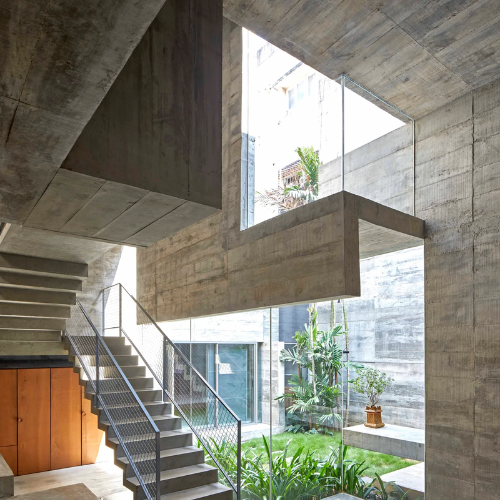
Light as a Design Driver
Daylight in a tightly packed urban setting is both a problem and an opportunity. The illumination is carefully brought into the house through the courtyards and other openings from several directions. The sun rays go down the house and thus the concrete surfaces get their share of the sunlight and the subtle changes in color and texture take place as the sun moves.
These illuminated spaces are not only for the visual comfort but also facilitate natural ventilation and thermal regulation. The air is moving without restrictions through the courtyards and thus the need for providing mechanical cooling is less and the indoor air quality is good in a humid climate such as that of Chennai. The views to the sky and the greenery from the framed openings provide the moments of serenity and strengthen the connection of the home with nature.
Structural Precision and Material Restraint
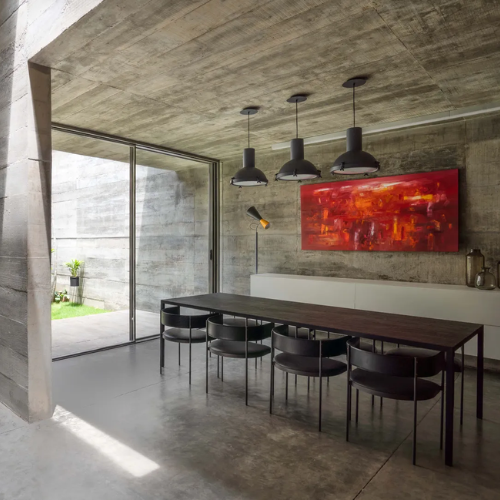
The house is a very transparent and harmonious composition from the structure perspective. The majority of the lower floor is open and the columns from the upper levels are transferred to the ground floor in order to keep the free areas intact. The architectonic elements such as the staircases, walls, and slabs are multifunctional, since they serve not only as a structure, circulation, and separation of space but also connect each other visually.
The choice of materials is a very limited one, and it is done purposely. The major surfaces are defined by the exposed concrete, which gives not only the support but also the finish. Some wood is in the use for the doors, screens, and operable elements, thereby the interior gets the warmth and tactility. Glass is used in a very limited way, mainly where safety or enclosure is needed, thus transparency is not allowed to dominate the solidity of the architecture.
Elevated Private Spaces
The family's bedrooms are situated at the higher levels of the house and thus they get the advantage of a more peaceful and introspective environment. The rooms open onto small courts that let the daylight in and at the same time, maintain the privacy of the adjacent buildings. The bedrooms are comfortable and cozy, with the views being well-planned which subsequently connects the occupants to the outside without any exposure.
Vastu principles were the guiding light for the house orientation and the room placement. The rules were not considered as limitations but rather they were merged with the overall spatial logic, thus the circulation patterns getting influenced and the equilibrium in the plan being deepened.

Rethinking Urban Domestic Space
The residence in Chennai is a good example of how carefully devised spatial planning can turn a difficult site into a living environment that is not only comfortable but also generous. The openness that is here is not the result of big windows or large facades but rather it is the outcome of the careful organization of space, light, and movement within the house.
As a consequence, in this project, we are presented with a compelling model for residential architecture in an increasingly dense urban landscape that focuses on calm, continuity, and connection instead of spectacle. The house, by its internal shaping, demonstrates that even the most limited urban plots can possess the quality of openness and ease, hence, a home that is both grounding and liberating can be created.
Image- architecturaldigest.in





.png)